Physics System Constraints Solver reads connection signals
It looks for body names, connection descriptions, fixed-length language, pulley geometry, rigid links, hinge points, tracks, guides, and motion directions.
Free connected-system physics helper
Paste a physics prompt with multiple connected or restricted objects. The Physics System Constraints Solver breaks down the system structure, identifies rope, pulley, rigid, hinge, or contact constraints, explains velocity and acceleration relations conceptually, estimates degree-of-freedom changes, and suggests how many equations your setup may need.
The Physics System Constraints Solver is a structure and constraint-logic tool, not a numerical solver. It helps you see which bodies are connected, which constraint types appear, how motion variables relate conceptually, how constraints reduce degrees of freedom, and how to organize equations before calculation.
Fill only what you know. Object names, connection words, fixed distances, ideal rope assumptions, and motion directions make the Physics System Constraints Solver more specific.
The Physics System Constraints Solver keeps connected-object problems focused on structure, constraints, motion relations, degrees of freedom, and equation setup.
Separate bodies first, then map which objects are connected by ropes, pulleys, rods, hinges, contacts, tracks, or guides.
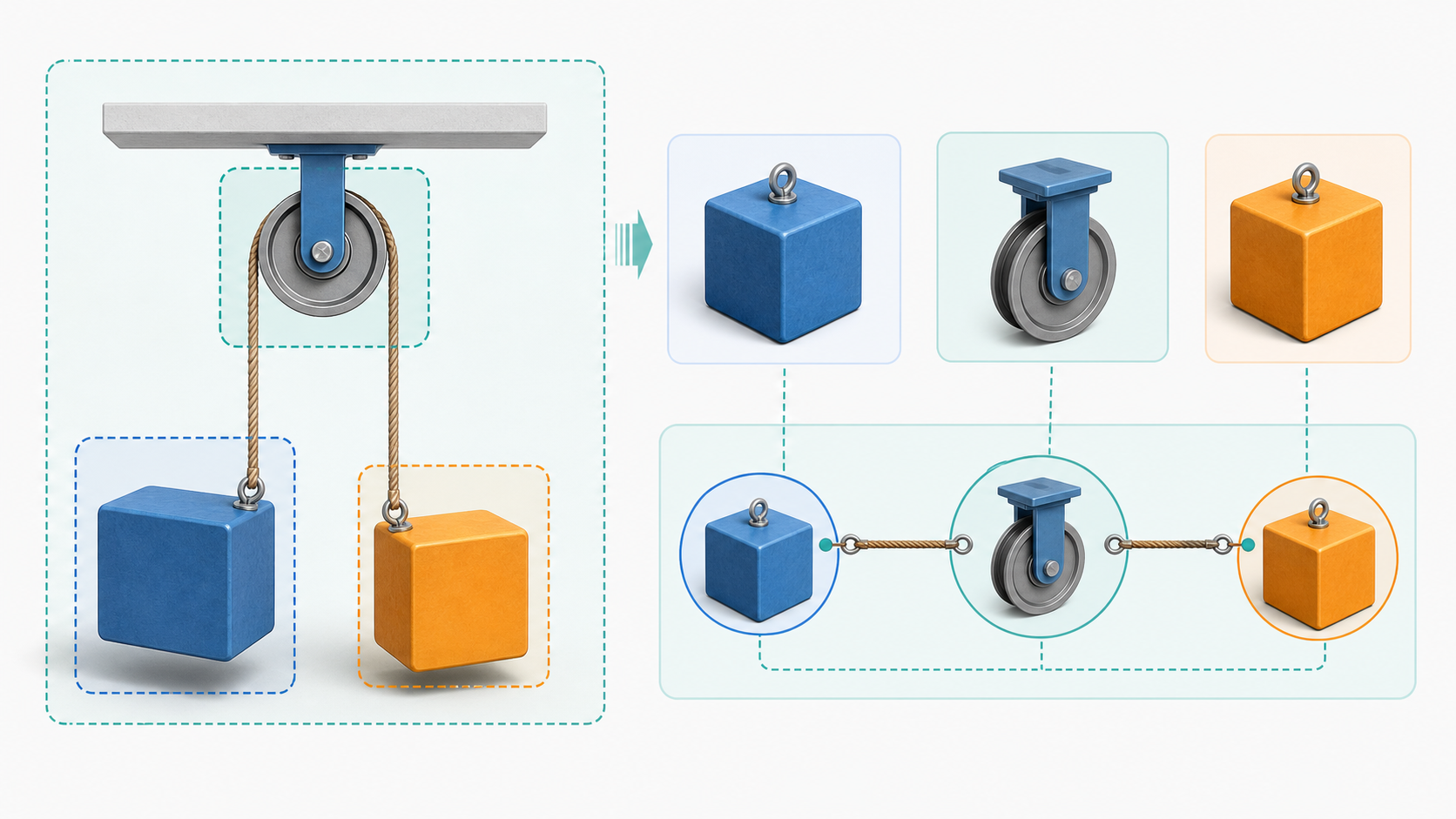
Classify each connection as rope, pulley, rigid, hinge, or guided contact so the right motion relation can be written.
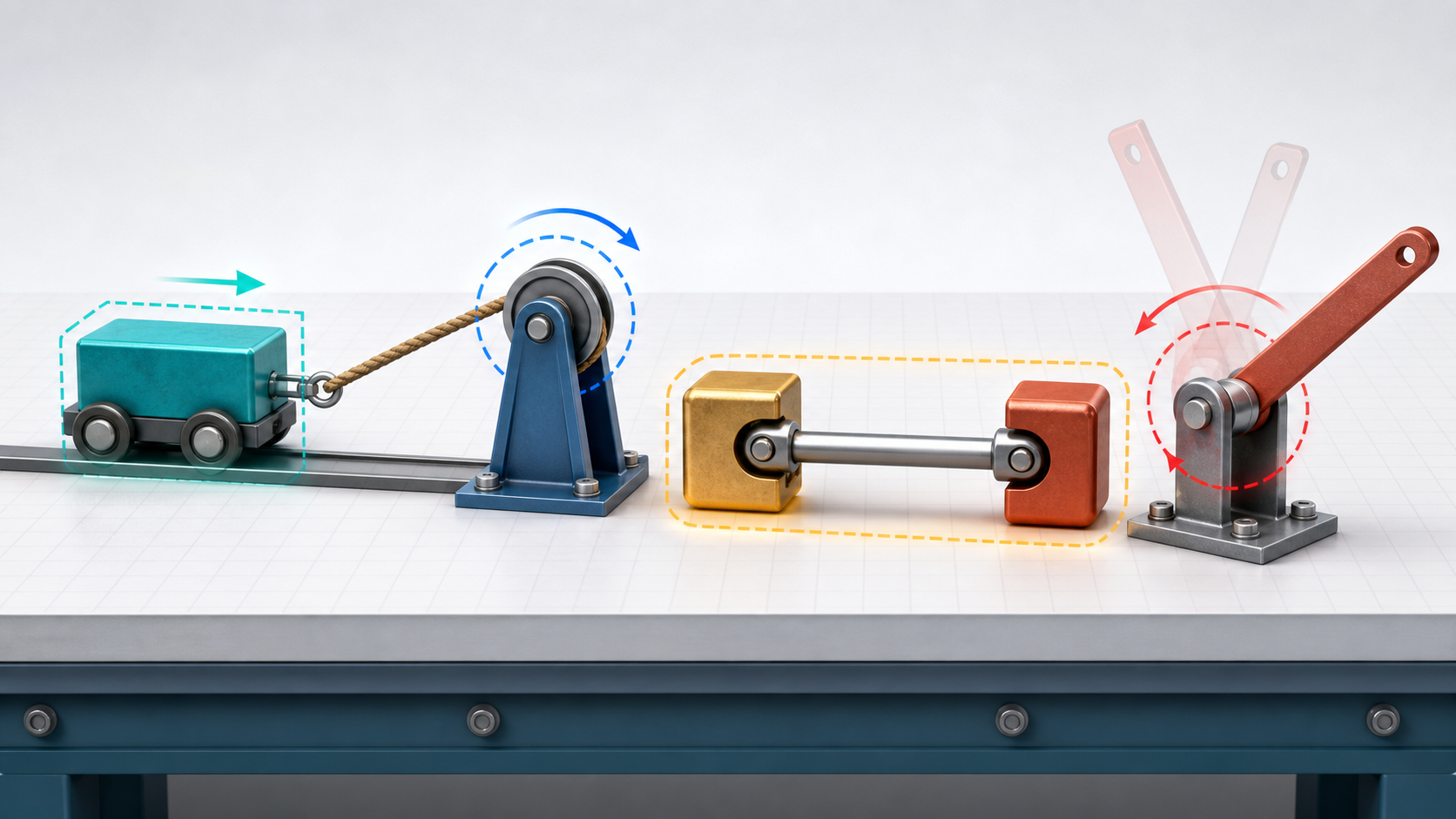
See how restrictions reduce independent coordinates and why extra constraint equations must accompany force or torque equations.

The Physics System Constraints Solver uses browser-side text signals and your marked constraints to organize the model before calculation.
It looks for body names, connection descriptions, fixed-length language, pulley geometry, rigid links, hinge points, tracks, guides, and motion directions.
The result explains velocity and acceleration constraints conceptually, including equal-magnitude rope relations, pulley ratios, fixed-distance links, and blocked directions.
It gives a practical count of body equation groups plus constraint relation groups so you know what must be linked before solving.
Use the Physics System Constraints Solver when the hard part is understanding how connected bodies are restricted, not calculating final numbers.
Include every object, how the objects are connected, which distances are fixed, and what the question asks. Qualitative wording is enough.
Use the checkboxes for rope, pulley, rigid, hinge, and contact or guided motion. These signals help the analysis avoid confusing force interactions with geometric constraints.
Check the body list, constraint type, velocity and acceleration relation, degree-of-freedom note, and equation-count hint before writing formulas.
If the equation count feels too low, you probably combined bodies too early or forgot a constraint relation.
Common questions about what the Physics System Constraints Solver does, what it avoids, and how to use it for connected-object systems.
No. The Physics System Constraints Solver does not output exact accelerations, tensions, reaction forces, positions, or final numeric answers. It focuses on structure, constraints, degrees of freedom, and equation setup.
Yes, at a conceptual setup level. The Physics System Constraints Solver can identify pulley constraints, distinguish fixed versus movable pulley behavior when the prompt states it, and remind you to write rope-length relations before acceleration equations.
No. The Physics System Constraints Solver deliberately avoids Jacobians, constraint matrices, numerical linear algebra, and simulation engines. It is for homework-style modeling logic and setup clarity.
The Physics System Constraints Solver recognizes rope or cable, pulley, rigid or fixed-distance, hinge or pivot, and contact or guided-motion constraints. You can mark them manually if the wording is brief.
The Physics System Constraints Solver gives a conceptual degree-of-freedom note by comparing object coordinate groups with detected constraint relations. It is not a formal rank or Jacobian calculation.
Yes. The current Physics System Constraints Solver runs in your browser after the page loads. It uses local text and checkbox signals, so your physics prompt is not uploaded for analysis.
Use the Physics System Constraints Solver before calculation, especially when you are unsure which bodies are independent, which connection creates a motion relation, or how many equations must be linked.
The Physics System Constraints Solver helps you map connected bodies, identify constraints, reduce degrees of freedom conceptually, and organize equation setup.
When the structure is clear, move to a calculation tool only if the problem asks for numerical values.
This tool is for structure and constraint-logic analysis only, not final answers or simulation.