The Path Connection Puzzle Solver models every cell
Each square can be empty, an endpoint, or part of exactly one path. That prevents repeated cells, shared cells, branching, and crossing in one consistent board state.
Free Online Path Connection Puzzle Solver
Enter matching number or color endpoints on a square grid and the Path Connection Puzzle Solver searches locally for continuous, non-branching paths. Use Connect Pairs mode for open coverage puzzles, or Fill Every Cell mode for Numberlink and Flow Free style grids that must cover the whole board.
Choose a grid size, select a pair, then click two endpoint cells for each number or color. The Path Connection Puzzle Solver connects equal endpoints with paths that do not cross, branch, revisit cells, or share cells.
Browser search is capped at 7×7 and 6 pairs so the tool stays responsive. Larger printed puzzles can be tested in sections or simplified first.
Select a pair, then click cells to place or move its two endpoints. Click an endpoint again to remove it.
Each pair needs exactly two endpoints before solving.
This page solves grid-cell path connection puzzles where each path is laid through neighboring cells. It does not solve Hashi, Bridges, screenshot recognition, saved game imports, online level libraries, leaderboards, or automated play in a real game.
Endpoint pairs
0
Covered cells
0
Uncovered cells
0
Solutions seen
0
This single page combines Numberlink Solver, Flow Free Solver, Arukone Solver, and Pair Path Puzzle Solver intent because they all route paired endpoints through neighboring grid cells.
Place number or color endpoint pairs directly on the grid. The solver treats every pair as a continuous path target and keeps the input manual, private, and browser-local.
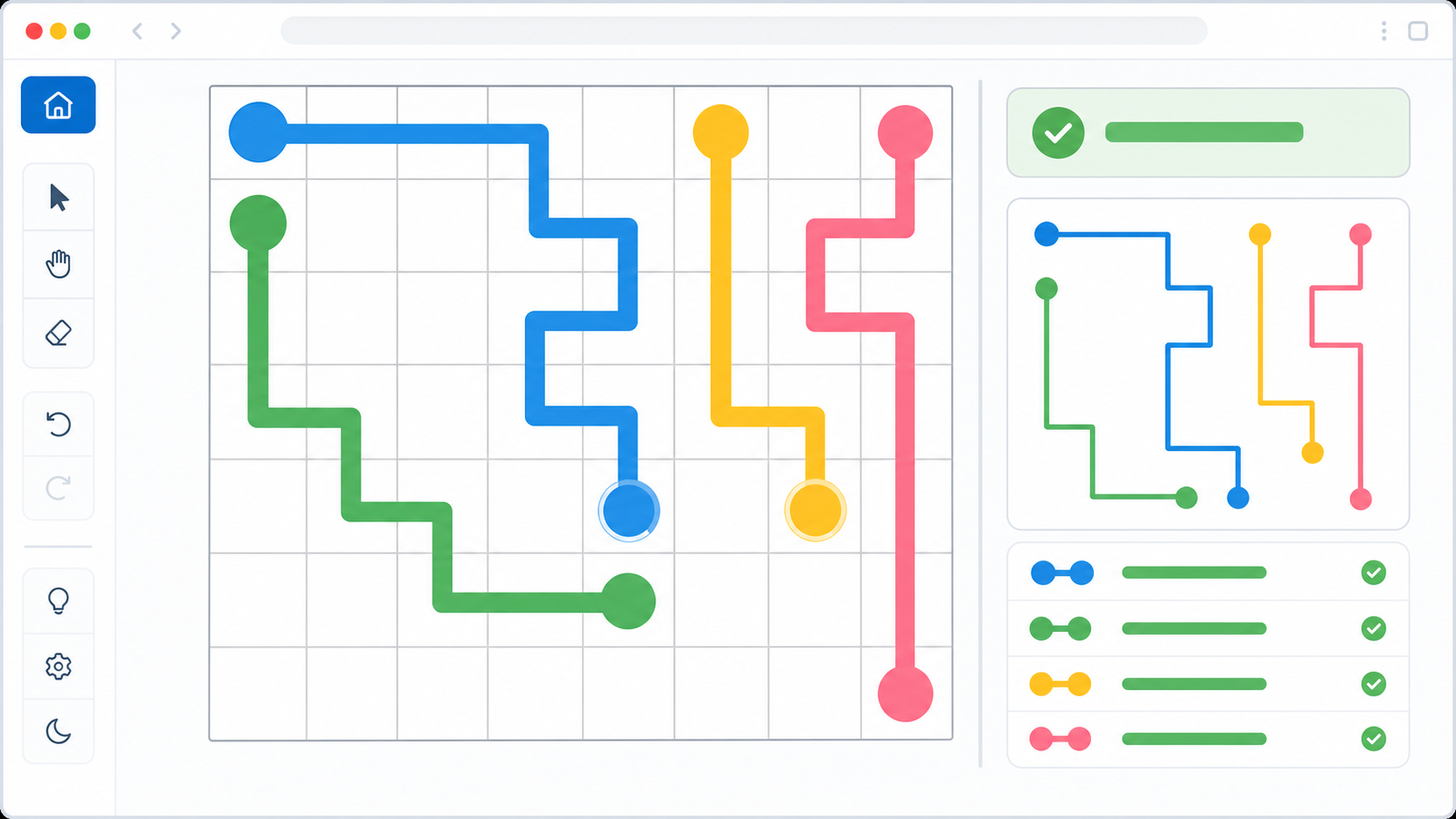
Switch to Fill Every Cell mode when your puzzle expects all paths together to cover the entire grid, as in many Numberlink and Flow Free style layouts.
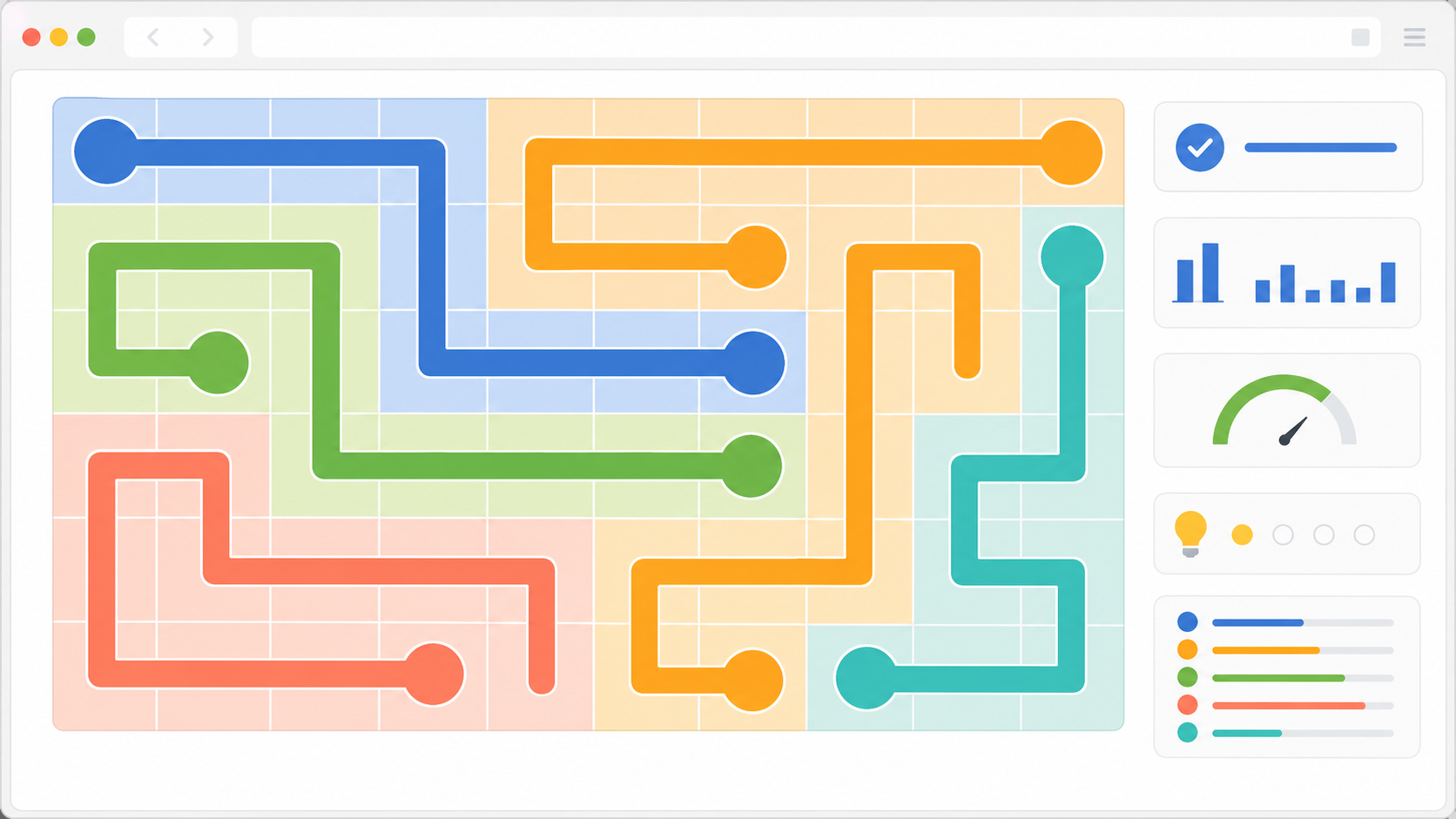
Review covered cells, uncovered cells, unreachable endpoints, dead-end warnings, no-solution notes, multiple-solution hints, and optional reasoning steps after each run.
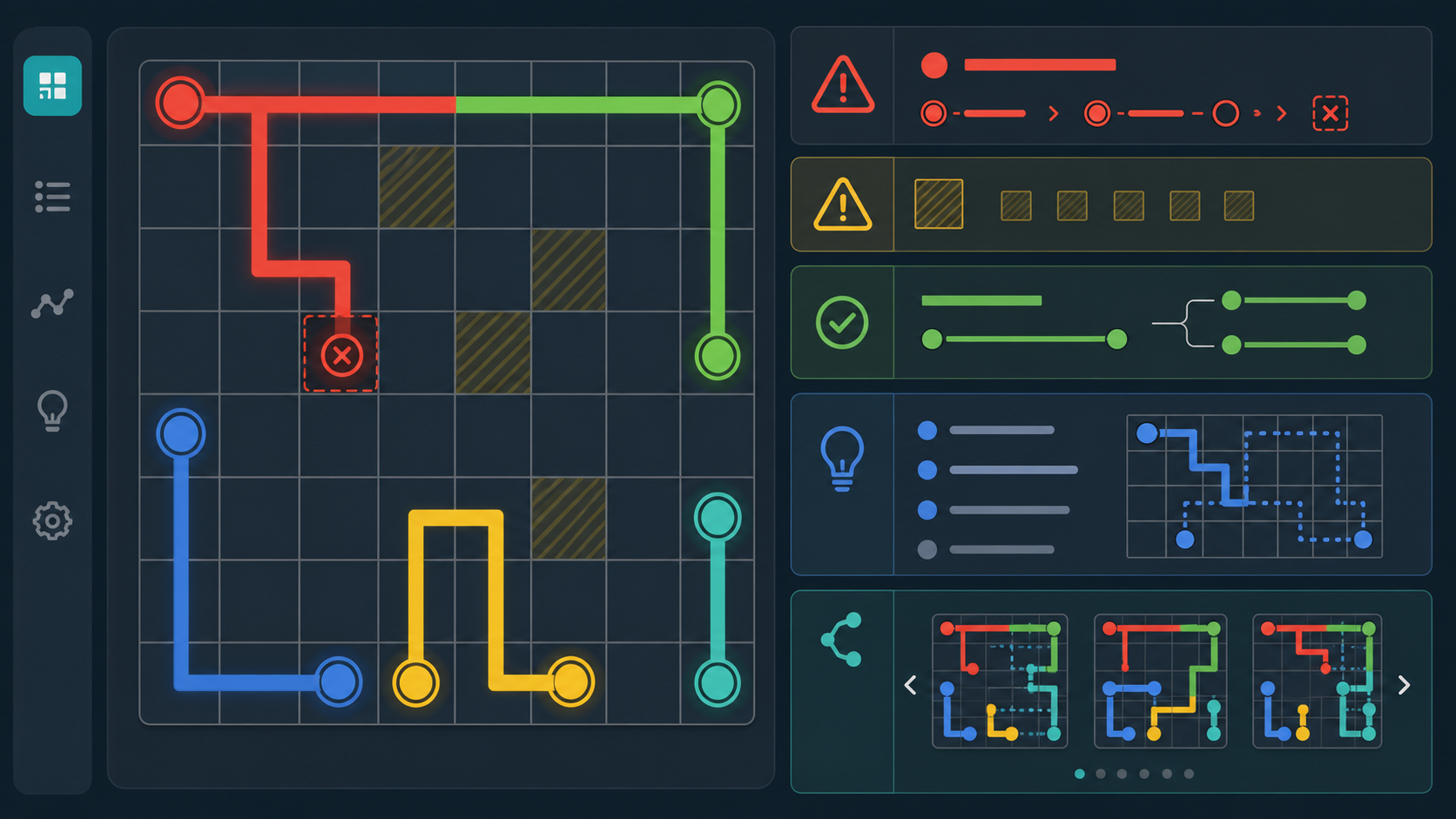
The Path Connection Puzzle Solver uses grid-path state rather than line segments between separate clue nodes.
Each square can be empty, an endpoint, or part of exactly one path. That prevents repeated cells, shared cells, branching, and crossing in one consistent board state.
Before expensive search, the tool verifies that every pair can still reach its mate through open neighboring cells while other endpoints remain blocked.
DFS proposes candidate paths, then backtracking combines them so no two routes share a square. A second-solution search flags ambiguous puzzles.
Use these tips when transcribing Numberlink, Flow Free, Arukone, or pair path puzzle boards.
Use Connect Pairs when only matching endpoints must be connected. Use Fill Every Cell when the final answer must cover every grid cell.
If a puzzle looks solved but Fill Every Cell fails, compare the uncovered-cell count with the original rules.
Every active number or color must appear exactly twice. Leave unused pairs blank and avoid placing a third endpoint with the same label.
For color-only puzzles, the labels still help you copy and audit the result.
This page is a manual grid-path solver. It does not read screenshots, import game saves, fetch level databases, compare times, or control any real game.
Keeping the search local makes the tool useful for printed puzzles, classroom grids, and self-made puzzle layouts.
Common questions about using the Path Connection Puzzle Solver for Numberlink, Flow Free, Arukone, and paired endpoint puzzles.
Yes. Numberlink, Arukone, Flow Free style boards, and pair path puzzles all ask you to connect matching endpoints through neighboring grid cells, so this page keeps those closely related solving intents together.
Connect Pairs only requires every matching endpoint pair to be connected by a continuous non-crossing path. Fill Every Cell also requires the union of all paths to cover every square on the board.
No solution means the entered endpoints cannot satisfy the selected mode. Common causes include a misplaced endpoint, an incomplete pair, a board that needs unused cells while Fill Every Cell is selected, or a layout that forces paths to share a cell.
Yes. After finding one layout, the solver searches for another valid path combination. If it finds a second layout before the search limit, it marks the puzzle as multi-solution.
No. The grid editor, DFS search, backtracking, coverage checks, diagnostics, and copied results all run in your browser after the page loads.
No. This tool lays paths inside grid cells between matching endpoint pairs. Hashi and Bridges use a different bridge-count rule set, so they belong in a separate solver.
No. This version intentionally avoids screenshot recognition, OCR, saved game imports, online level libraries, leaderboards, and automated play. Enter your endpoint grid manually and solve it locally.
After this Path Connection Puzzle Solver, browse more free logic, number, word, and game puzzle solvers.
Each SolverBox tool stays focused on one puzzle model with browser-local input and results.
Numberlink Solver, Flow Free Solver, Arukone Solver, and Pair Path Puzzle Solver stay combined on this page.