Mechanics Reasoning Solver reads mechanics signals
It looks for bodies, forces, contact surfaces, ropes, inclines, equilibrium language, acceleration, pivots, hinges, and torque cues.
Free mechanics modeling helper
Paste a mechanics problem about forces, motion, or rotation. The Mechanics Reasoning Solver helps you identify the body system, outline the free-body structure, reason about force directions, check ΣF = ma readiness, spot torque trends, and choose the right modeling path before calculation.
The Mechanics Reasoning Solver is not a numeric calculator. It reads your prompt and optional modeling clues, then returns a structured mechanics analysis: body system, text free-body structure, force direction relationships, ΣF = ma condition, coordinate decomposition, torque insight, and a recommended Newton, equilibrium, or dynamics path.
Fill only what you know. Words like rough, smooth, hinge, rope, rest, constant speed, or starts moving are useful even without numbers.
The Mechanics Reasoning Solver keeps the first physics step focused on modeling: system, forces, motion, axes, and torque insight.
Convert a word problem into a text free-body structure before deciding which formulas are safe to use.

For ropes, pulleys, contact pairs, and multi-body prompts, the tool reminds you to model each body and then connect the constraints.
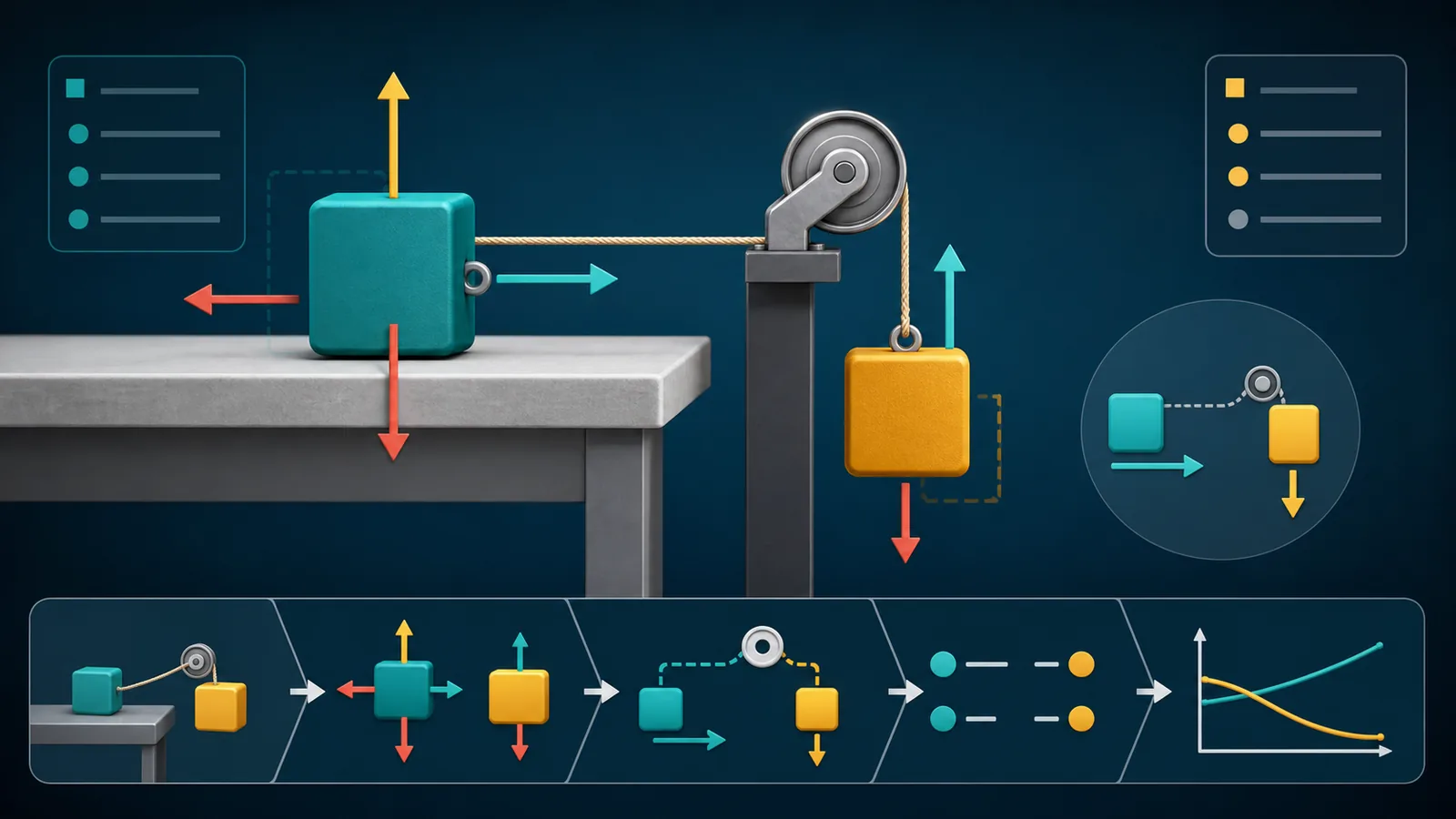
When a pivot, hinge, lever arm, or off-center force appears, the result adds torque intuition without splitting rotation into a separate tool.
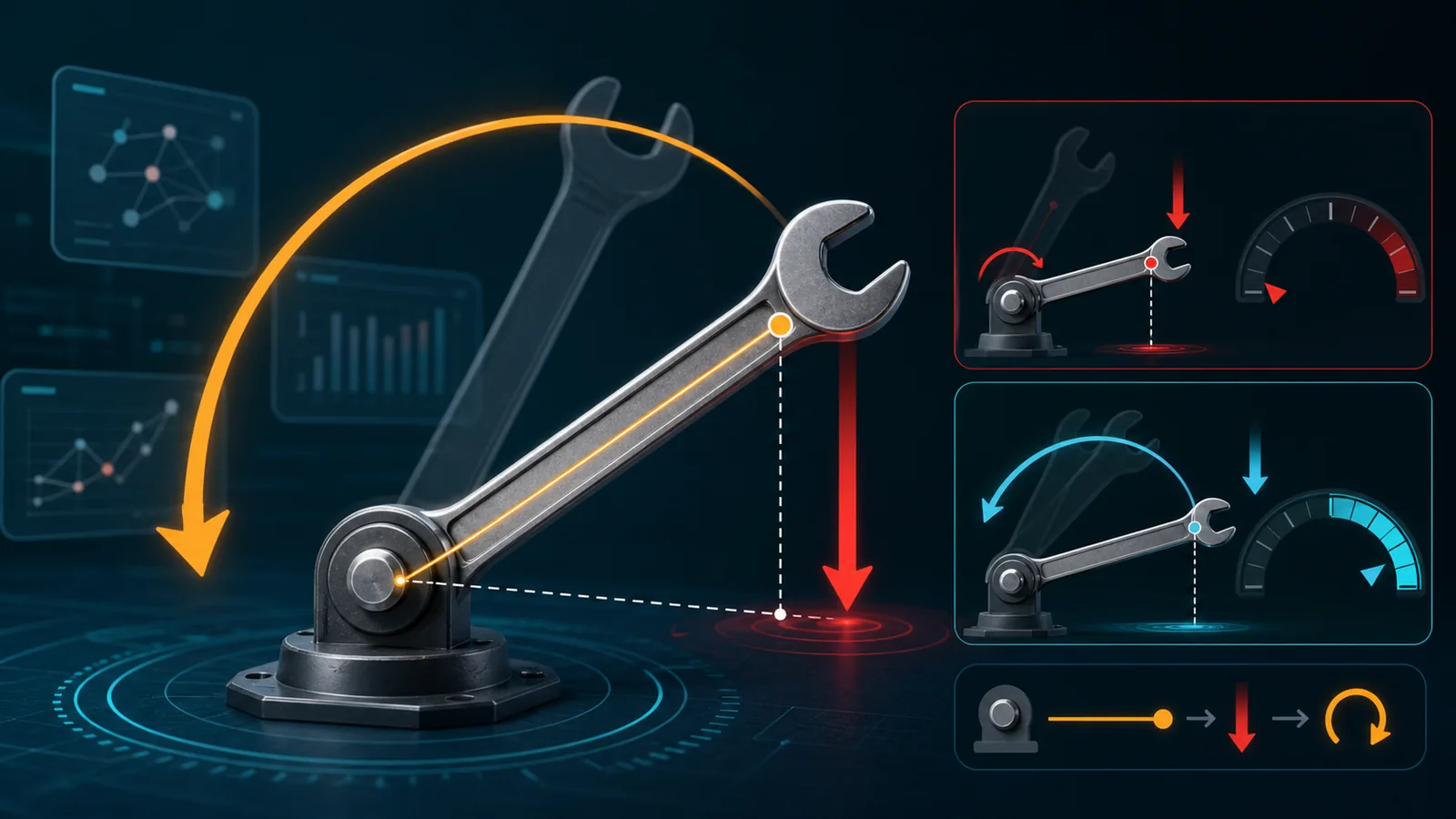
The Mechanics Reasoning Solver uses browser-side text signals and your modeling clues to organize mechanics thinking, not calculate answers.
It looks for bodies, forces, contact surfaces, ropes, inclines, equilibrium language, acceleration, pivots, hinges, and torque cues.
The result groups the problem into system identification, free-body structure, force direction notes, ΣF = ma readiness, axes, torque, and modeling path.
Depending on the signals, it recommends Newton, equilibrium, or dynamics reasoning before any numeric solver is used.
Use the Mechanics Reasoning Solver when the hard part is knowing what system to model and which relationships come before formulas.
Include the object, contact surface, rope, hinge, pivot, force directions, and motion state. Even qualitative wording is enough for a useful modeling frame.
Use the clue fields and quick signals to mark multiple bodies, inclines, friction, ropes, equilibrium, or rotation. These clues make the result more specific.
Check whether the system boundary, force directions, axes, and torque insight make sense. Only then move to equations or numeric calculation.
If the Mechanics Reasoning Solver says ΣF = ma is conditional, rewrite the force list or split the system into separate bodies before solving.
Common questions about what the Mechanics Reasoning Solver does, what it avoids, and how to use it for force, motion, and torque reasoning.
No. The Mechanics Reasoning Solver intentionally does not perform numerical calculation, final velocity output, final acceleration output, or formula substitution. It helps you build the modeling framework before calculation.
The Mechanics Reasoning Solver combines forces analysis, motion reasoning, and torque intuition in one tool. It identifies the body system, outlines a text free-body structure, explains force directions, checks ΣF = ma readiness, recommends coordinate decomposition, flags torque trends, and suggests Newton, equilibrium, or dynamics modeling.
No. The Mechanics Reasoning Solver gives a text free-body structure so you know what to draw and label. You should still sketch the diagram if your homework, class, or exam expects one.
The Mechanics Reasoning Solver recommends coordinate decomposition when the prompt includes inclines, angled forces, surfaces that are not horizontal, or rotation contexts where a pivot and sign convention are needed.
No. The Mechanics Reasoning Solver keeps forces analysis, motion reasoning, and torque intuition merged because real mechanics problems often need all three ideas in the same modeling pass.
No. The current Mechanics Reasoning Solver runs in your browser after the page loads. It uses simple local text and field checks, so your prompt is not sent to a server for analysis.
The Mechanics Reasoning Solver is designed for the step before calculation. A qualitative result is useful because it clarifies the system, directions, assumptions, and equations you would later write.
The Mechanics Reasoning Solver helps you stop guessing and start modeling: identify the system, organize the free-body structure, choose axes, and check torque trends.
When the framework is clear, move to a calculation tool only if the problem asks for numbers.
This tool is for mechanics reasoning and modeling guidance only, not final numeric answers.