Lockpick Solver builds states
Each pin has a numbered state. The current lock core state is the full list of pin values, and the target is the unlock state you enter.
Free Online Lockpick Solver
Enter the pin positions, lock core state, linked pin effects, or click-change rules from a game puzzle. The Lockpick Solver searches possible operation orders, shows each state change, and flags no-solution or multi-solution setups in your browser.
Use this combined Lockpick Solver, Pin Lock Puzzle Solver, and Game Lock Puzzle Solver for abstract game minigames where clicking one pin changes one or more pin positions.
This tool is for fictional game lockpicking puzzles only. It does not provide real-world lock bypass instructions.
Only model abstract puzzle states from games. Do not use it for real locks, doors, padlocks, safes, password locks, access systems, bypass attempts, or illegal entry.
Each row is the pin you click. Each column is the pin that changes. Use +1, -1, +2, or 0 for no change. Values wrap around the lock core states.
Initial lock state
Target unlock state
Moves:
0
States checked:
0
Shortest solutions found:
0
No operations needed.
Set the fictional pin states and click rules, then run the Lockpick Solver.
No solution
Set the fictional pin states and click rules, then run the Lockpick Solver.
Multiple solutions
Set the fictional pin states and click rules, then run the Lockpick Solver.
This page keeps Lockpick Solver, Pin Lock Puzzle Solver, and Game Lock Puzzle Solver together because the same abstract state-search logic handles them.
Model the fictional puzzle with pin positions, target lock core states, and the number of possible states each pin can occupy.
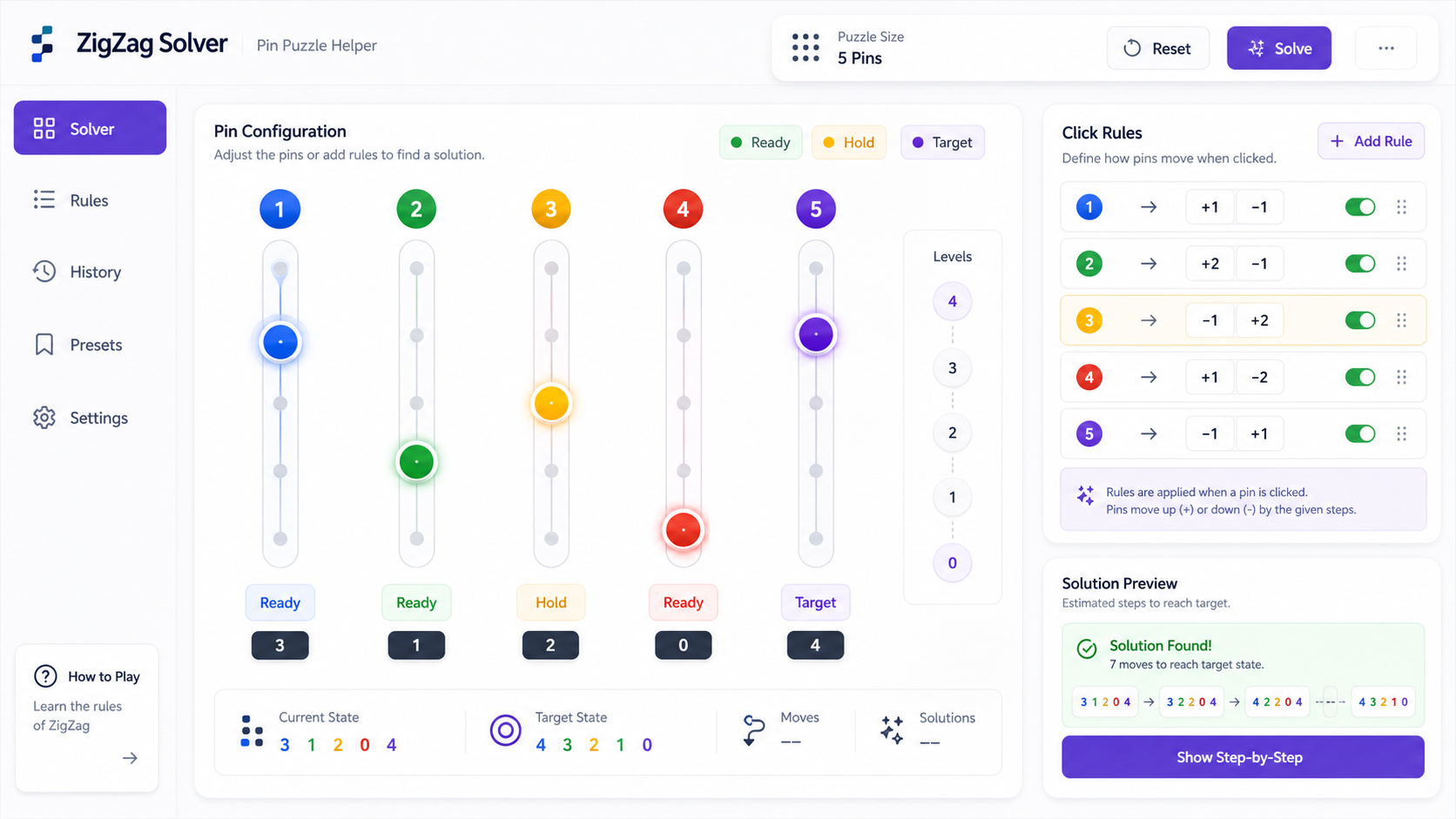
Review each operation in order, including the lock core state before and after every clicked pin.
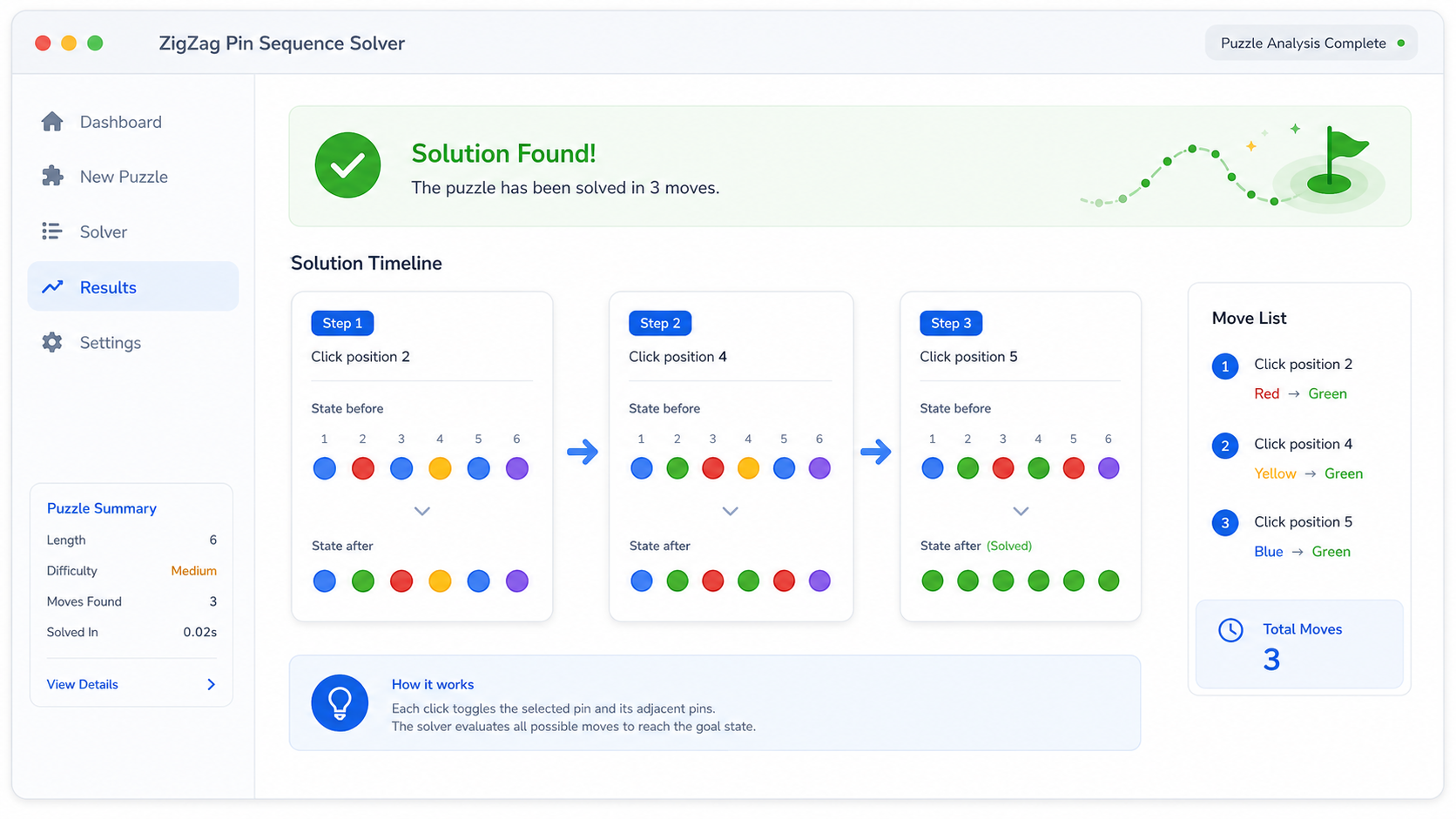
See whether the fictional puzzle has no solution, one shortest route, or multiple shortest operation sequences.
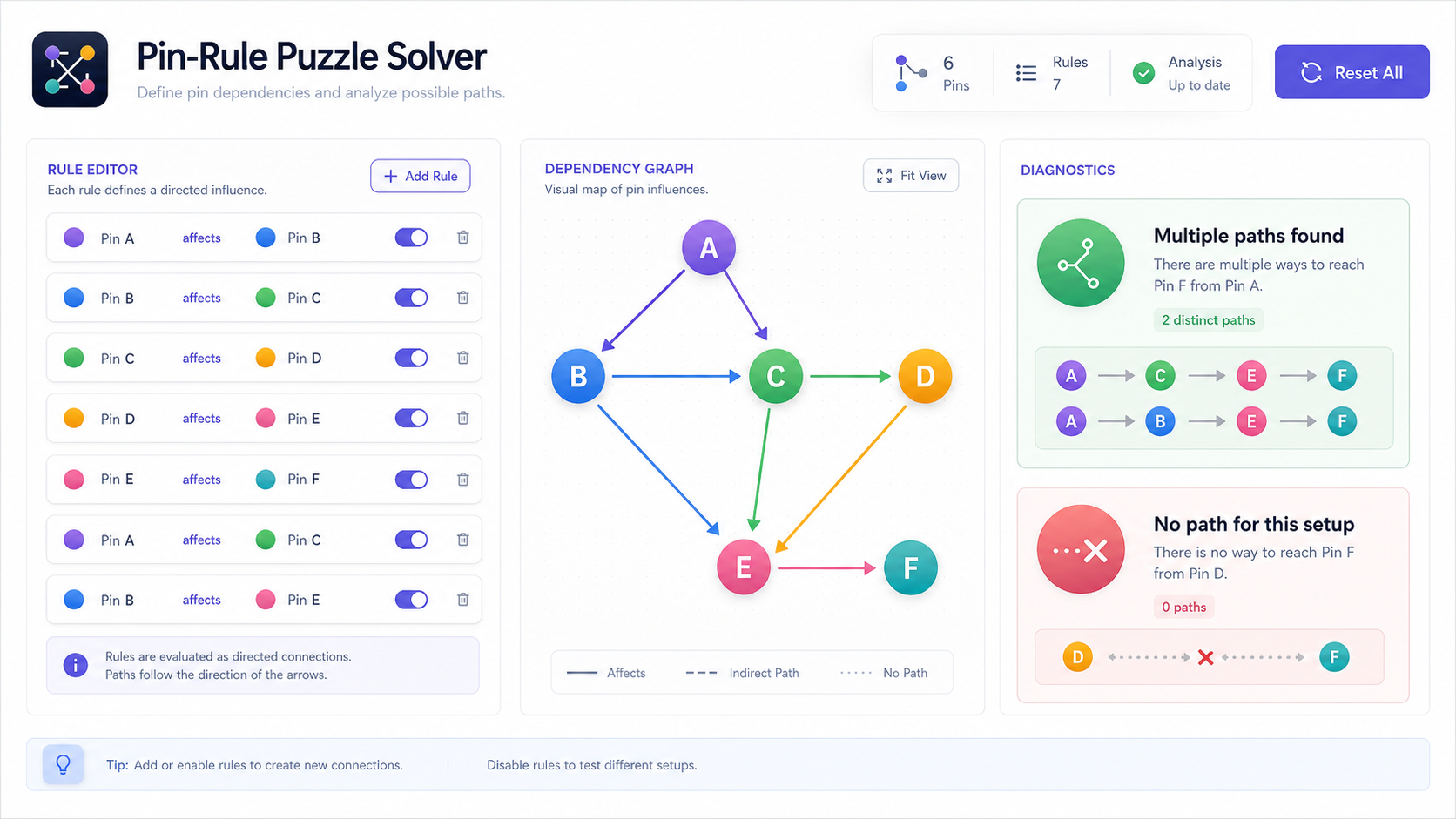
The Lockpick Solver treats a game lock as a finite abstract state machine, not as a real lock or security device.
Each pin has a numbered state. The current lock core state is the full list of pin values, and the target is the unlock state you enter.
When you click a pin, the solver applies the row of changes for that pin, including linked pins and wraparound state changes.
A breadth-first search checks operation orders from shortest to longer paths, then reports no solution, one route, or multiple shortest routes.
Use these tips to translate a fictional game lockpicking minigame into abstract pin states the Lockpick Solver can search.
Map each visible game pin, tumbler, notch, dial, or lock core marker to a numbered state. Use state 0, 1, 2, and so on instead of describing real hardware.
For each clickable pin, enter how the click changes every affected pin. A simple puzzle may only change itself; a harder one may move neighbors or remote pins.
This Lockpick Solver is only for abstract fictional game puzzles and recreational puzzle logic. It is not a guide for opening real locks or bypassing access systems.
Do not enter real-world lock, door, safe, padlock, password, alarm, or access-control information.
Common questions about using the Lockpick Solver as a Pin Lock Puzzle Solver and Game Lock Puzzle Solver.
No. This Lockpick Solver is only for fictional game lockpicking puzzles with abstract pin states. It does not teach real-world lock bypass, door entry, password-lock cracking, safe opening, or illegal access.
Yes. If your pin lock puzzle is a game minigame where each click changes numbered pin positions, enter the initial state, target state, and click-change rules on this combined Lockpick Solver page.
Yes. The click-rule table lets one clicked pin change itself, neighboring pins, or any other pin. This covers many fictional game lock puzzle rules without splitting them into separate tools.
No solution means the target lock core state is not reachable from the initial state under the rules you entered. Check the target, wraparound state count, and each linked pin change.
Multiple solutions means more than one shortest operation order reaches the target. The page shows one path in detail and tells you that other shortest paths also exist.
No. The Lockpick Solver runs in browser JavaScript after the page loads. Pin states, click rules, paths, and diagnostics stay local to your device.
The browser search is designed for compact fictional game puzzles. If you choose too many pins or too many states per pin, the page asks you to simplify the setup so it stays fast.
SolverBox keeps puzzle helpers free, browser-based, and focused on abstract recreational puzzles.
After this Lockpick Solver, browse more game, logic, word, and number solvers.
No account required — solve fictional game puzzle states directly in your browser.