Morse Code Solver detects clue format
The tool normalizes common dot and dash symbols, checks whether the input looks like Morse code or plain text, and keeps the detected format visible beside the results.
Free Online Morse Code Solver
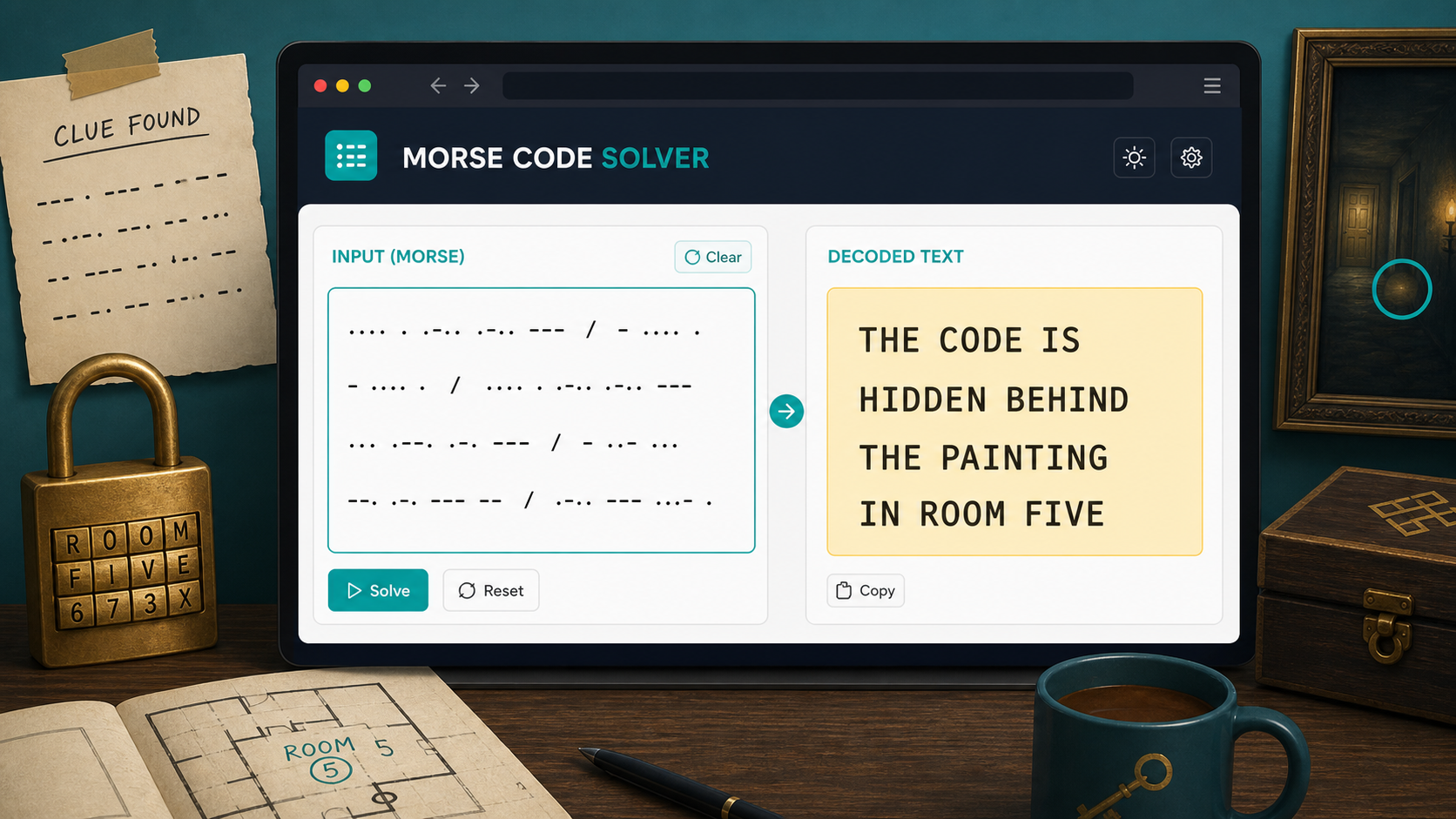
Paste dots, dashes, spaces, slashes, or plain English from an escape room clue, ARG trail, game secret, classroom worksheet, or paper puzzle. This Morse Code Solver runs in your browser. No audio upload, microphone access, account login, or external database is required.
Enter Morse code fragments, dot-dash symbols, slash-separated words, or plain English. The Morse Code Solver detects the input style, decodes Morse code to text, converts text to Morse code, explains separators, flags unknown pieces, and suggests possible readings for short unspaced Morse runs.
This Morse Code Solver runs fully in your browser. It does not do audio Morse recognition, microphone real-time decoding, radio signal analysis, image OCR, ham radio training, external Morse databases, or historical telegraph lookup.
| Character | Morse |
|---|
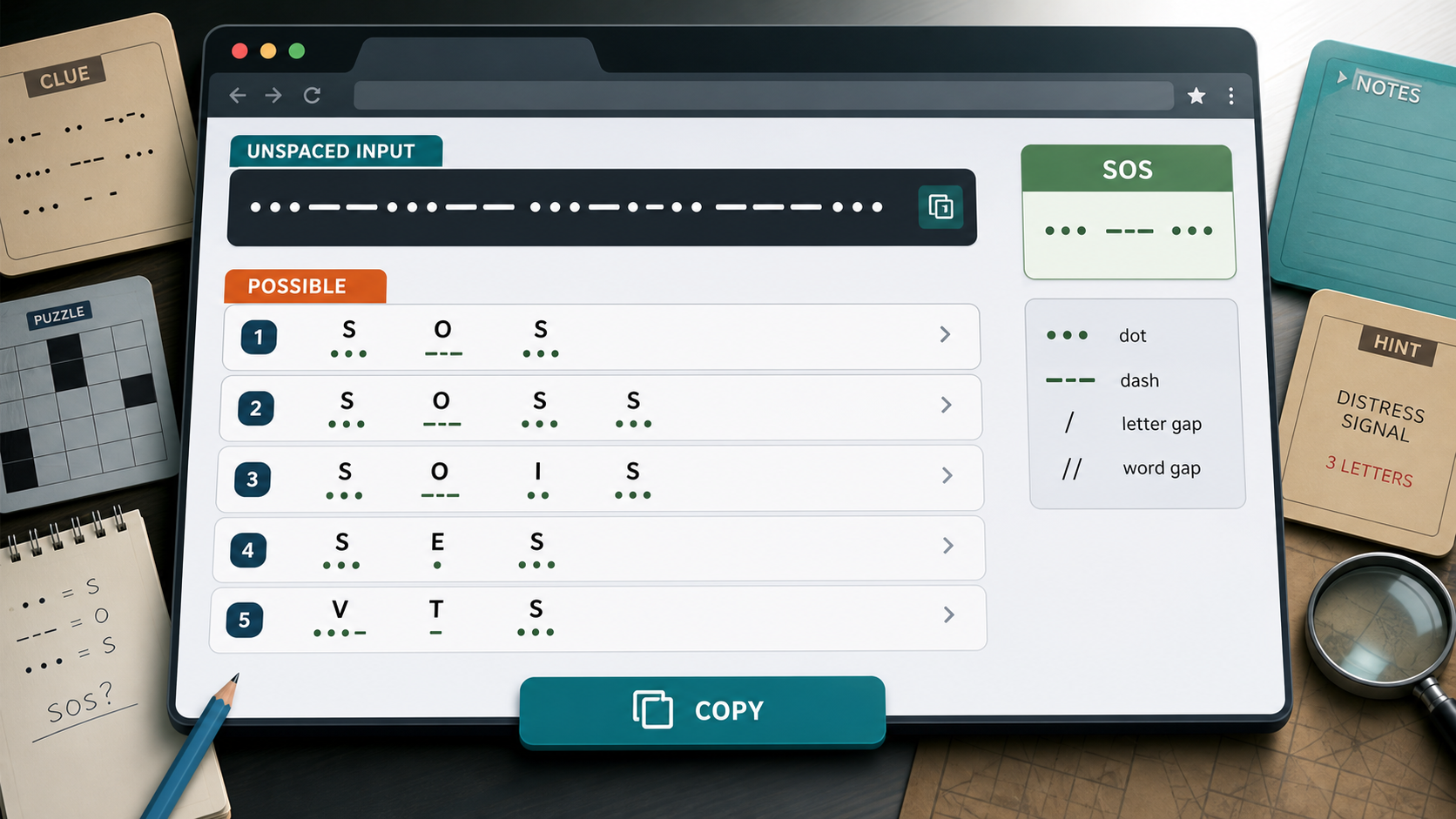
Unspaced Morse code is ambiguous. These are possible readings, not a guaranteed unique answer.
This Morse Code Solver keeps Morse Code Decoder, Morse Code Translator, Morse Code Puzzle Solver, Morse Code to Text, Text to Morse Code, SOS Morse Code Decoder, Morse Code Alphabet Chart, and Morse Code Reader intent on one page.
Paste a dot-dash message from a lock clue, game secret, class sheet, or hidden note and get a readable decoded text result without sending the clue away.
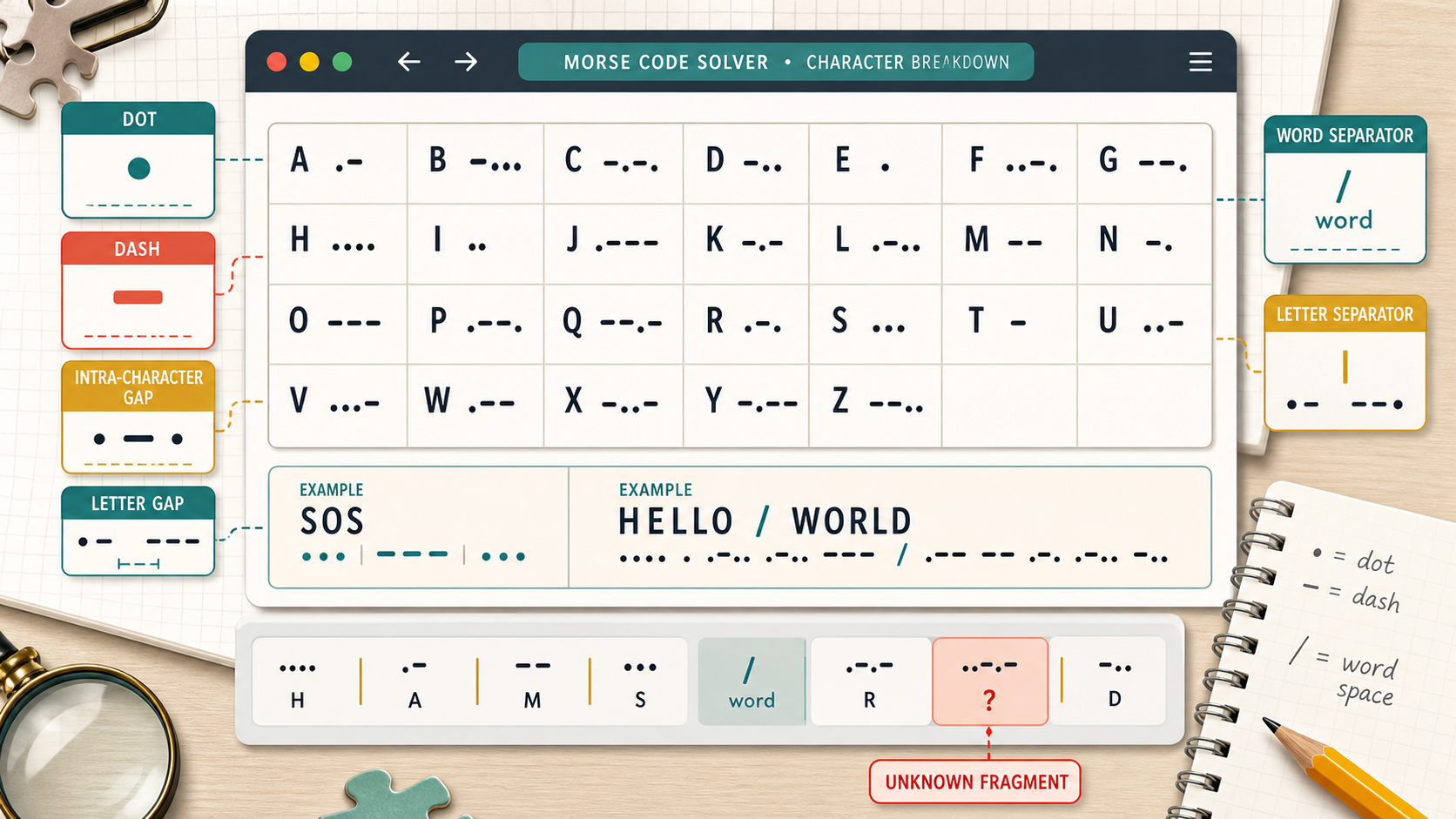
Inspect each recognized character, see which fragments failed, and use separator notes when a puzzle uses spaces, slashes, or line breaks inconsistently.
When a clue removes letter spaces, the Morse Code Solver lists limited candidate readings and clearly marks that continuous Morse may not decode uniquely.
The Morse Code Solver is a browser-side puzzle helper for text Morse, not an audio, radio, camera, or training system.
The tool normalizes common dot and dash symbols, checks whether the input looks like Morse code or plain text, and keeps the detected format visible beside the results.
Morse fragments are decoded to English text, while supported English letters, numbers, and common punctuation are also converted back into Morse code.
Unknown fragments are listed, separators are explained, and short continuous Morse strings receive possible readings instead of a false promise of one unique answer.
Use these Morse Code Solver tips for escape-room clues, ARG hints, game secrets, paper puzzles, and classroom Morse code practice.
Use periods, middle dots, hyphens, long dashes, spaces, slashes, or line breaks. The Morse Code Solver normalizes common dot-dash styles before decoding.
A single space usually means the next Morse letter. A slash, line break, or extra spacing usually means a new word. Many puzzle notes are informal, so the notes help you adjust the clue.
This page is intentionally a pure front-end text puzzle tool. It does not analyze audio files, listen through a microphone, process radio signals, read Morse from images, or train ham radio timing.
If a clue has no spaces at all, compare the possible readings with nearby puzzle context instead of assuming the first candidate must be correct.
Common questions about using the Morse Code Solver as a decoder, translator, puzzle helper, SOS reference, and Morse alphabet chart.
Yes. Paste Morse fragments such as ... --- ... or .--. ..- --.. --.. .-.. ., and the Morse Code Solver decodes recognized letters, numbers, and common punctuation to English text.
Yes. Type normal English letters, numbers, and supported punctuation, and the Morse Code Solver creates a text-to-Morse result using spaces between letters and / between words.
Yes. The page is designed as a Morse code puzzle solver, so it shows decoded text, format detection, separator explanations, fragment breakdowns, unknown pieces, an SOS example, and a copy-ready result.
It can suggest possible interpretations for short unspaced Morse runs, but unspaced Morse is often ambiguous. The Morse Code Solver does not promise that a continuous string has one guaranteed decoding.
No. This is a text-only browser tool. It does not identify Morse from sound, microphones, radio signals, images, OCR, external databases, or historical telegraph records.
No. After the page loads, the Morse Code Solver runs in local browser JavaScript. Conversion, breakdowns, candidate explanations, chart lookup, and copying happen on your device.
SolverBox keeps puzzle helpers browser-based, practical, and focused on real solving workflows.
After this Morse Code Solver, explore more word, logic, number, and game puzzle tools.
No account required — solve Morse code clues directly in your browser.