Chemical Reaction and Stoichiometry Solver parsing
The tool reads formulas, parentheses, simple charges, and existing coefficients, then separates reactants from products without uploading the equation.
Free Online Chemical Reaction and Stoichiometry Solver
Chemical equations and calculations are processed locally in your browser. No reaction data is uploaded. This Chemical Reaction and Stoichiometry Solver combines a Chemical Equation Balancer, Reaction Type Identifier, Oxidation Number Checker, Redox Checker, Mole Ratio Solver, Limiting Reagent Solver, Theoretical Yield Solver, Percent Yield Solver, and Basic Gas Stoichiometry workflow in one page.
Enter one unbalanced or balanced basic chemical equation, then add optional known quantities such as grams, moles, particles, gas volume, actual yield, temperature, and pressure. The Chemical Reaction and Stoichiometry Solver checks element and charge conservation, balances coefficients, shows mole ratios, finds limiting and excess reagents, estimates theoretical yield, calculates percent yield, and explains basic gas stoichiometry steps.
Chemical equations and calculations are processed locally in your browser. No reaction data is uploaded. The Chemical Reaction and Stoichiometry Solver does not call a third-party chemistry API.
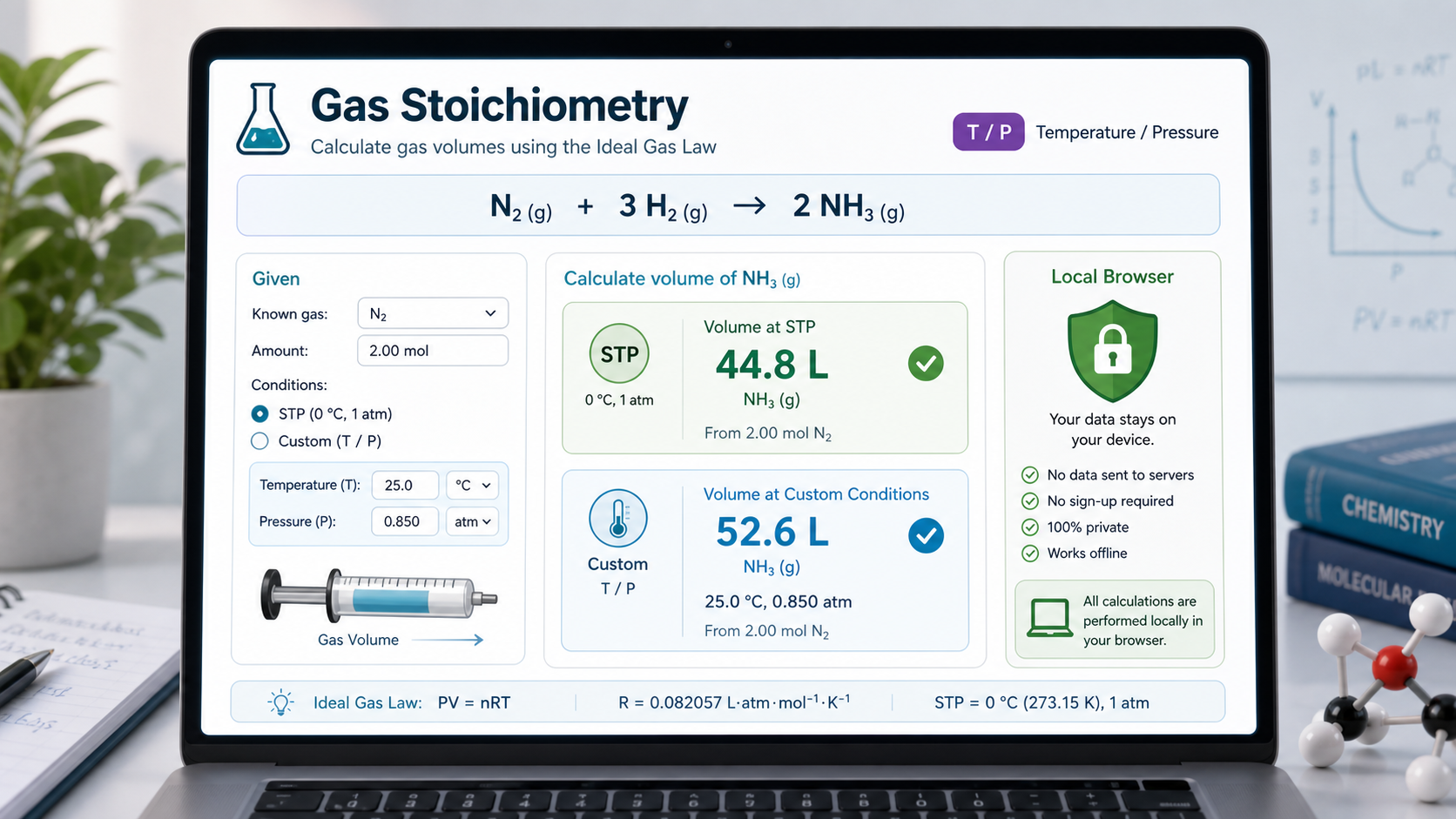
Gas volume lines use PV = nRT with these defaults unless the line includes its own K or atm value. Leaving the fields blank uses 273.15 K and 1 atm.
The Chemical Reaction and Stoichiometry Solver keeps the equation check, mole setup, limiting reagent, and yield calculation together so one reaction does not become nine separate pages.
Start with an unbalanced equation and the Chemical Reaction and Stoichiometry Solver calculates coefficients, atom counts, and charge status before using the equation for stoichiometry.
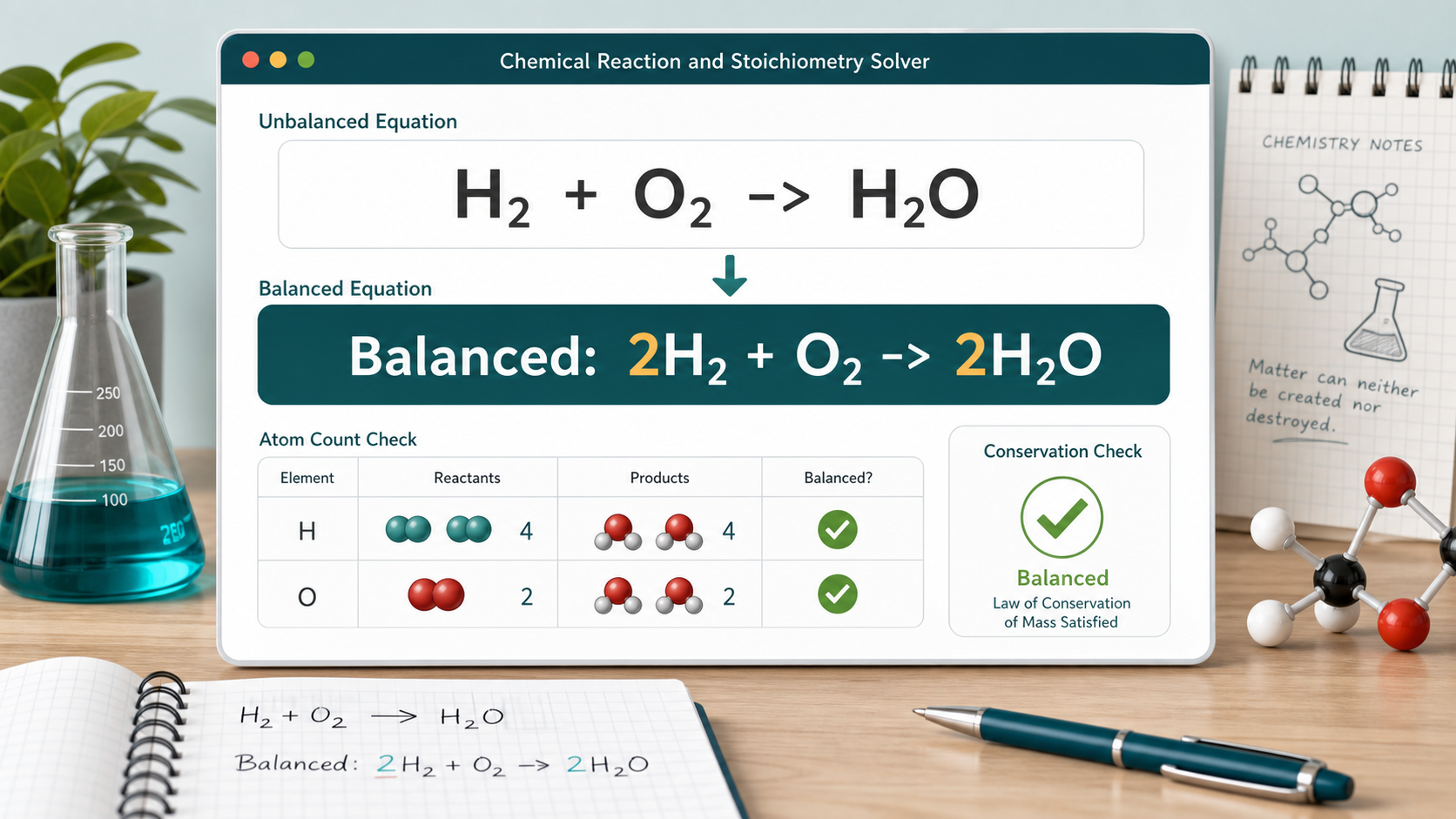
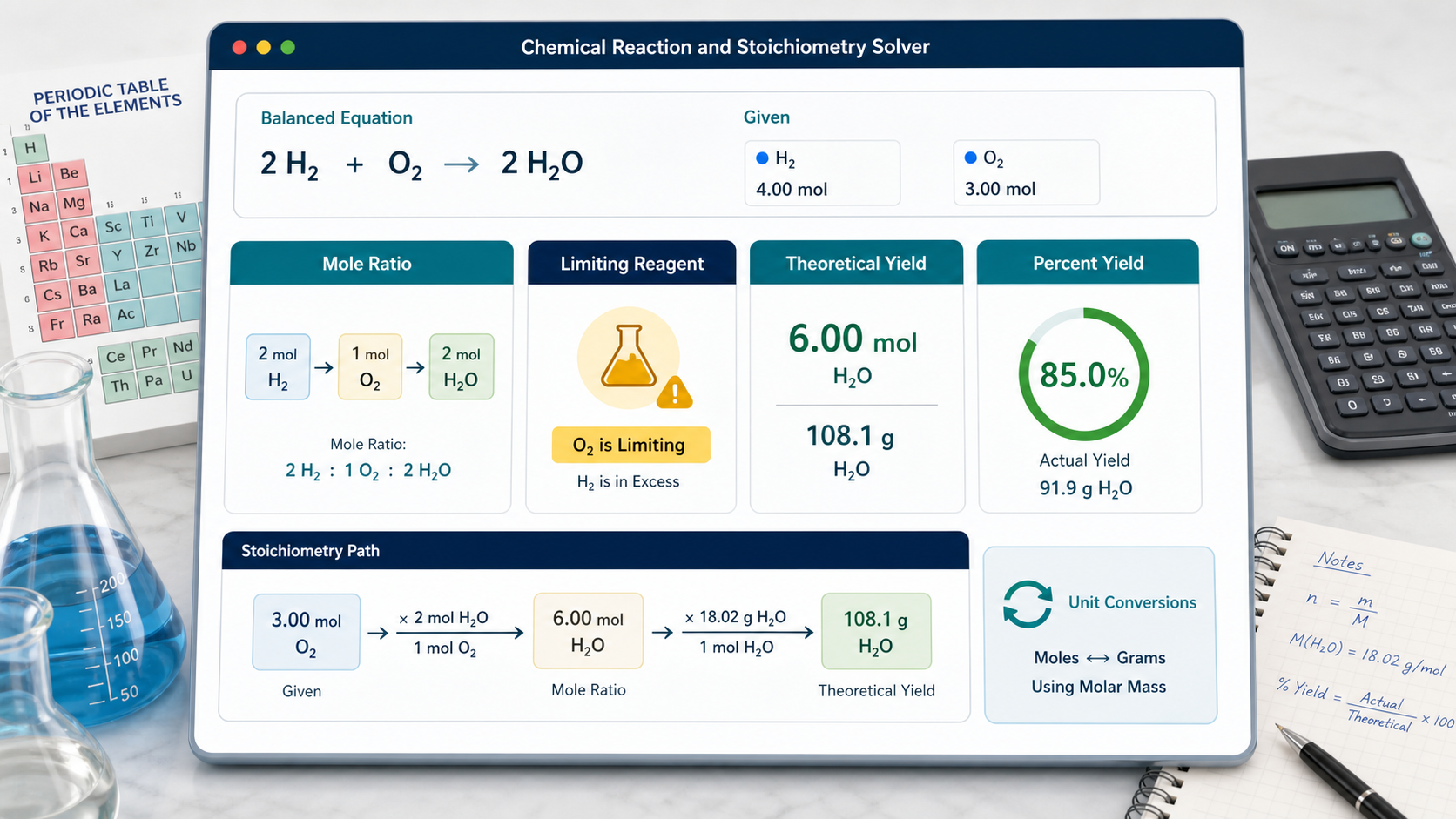
Masses, moles, particles, and gas volumes are converted into moles so the Chemical Reaction and Stoichiometry Solver can compare reaction extent and excess remaining.
For basic gas stoichiometry, the Chemical Reaction and Stoichiometry Solver uses PV = nRT with your temperature and pressure, then reports the assumption in the result panel.
The Chemical Reaction and Stoichiometry Solver uses a small static element table, molar masses, common oxidation-state heuristics, and basic reaction rules directly in the browser.
The tool reads formulas, parentheses, simple charges, and existing coefficients, then separates reactants from products without uploading the equation.
A browser-side conservation matrix finds small whole-number coefficients and checks that atom totals match across the balanced reaction.
Known quantities are converted to moles, compared by coefficients, and then converted back into theoretical yield, remaining excess reagent, or percent yield.
Use the Chemical Reaction and Stoichiometry Solver when you already know the reaction equation and need the balancing and stoichiometry workflow in one browser tool.
Type the reaction you want to analyze. The Chemical Reaction and Stoichiometry Solver can accept unbalanced or balanced basic equations.
Add known reactants or products one per line. For gas volume, the solver uses your temperature and pressure values in PV = nRT.
This page is built for basic educational stoichiometry, not reaction discovery, dangerous synthesis planning, industrial process design, or maintained reaction databases.
If a teacher or worksheet already gives the equation, this tool is a good fit. If the question asks what reaction will happen from arbitrary chemicals, it is outside scope.
Common questions about Chemical Reaction and Stoichiometry Solver input formats, balancing, redox checks, limiting reagents, yield, gas assumptions, privacy, and limits.
This Chemical Reaction and Stoichiometry Solver combines Chemical Equation Balancer, Reaction Type Identifier, Oxidation Number Checker, Redox Checker, Mole Ratio Solver, Limiting Reagent Solver, Theoretical Yield Solver, Percent Yield Solver, and Basic Gas Stoichiometry workflows on one page.
Yes. For basic formulas, the Chemical Reaction and Stoichiometry Solver builds an element conservation matrix and returns the smallest whole-number coefficients it can find.
Yes. Add known reactant amounts in grams, moles, particles, or gas volume. The Chemical Reaction and Stoichiometry Solver converts them to moles and compares moles divided by coefficients.
Yes. Add an actual yield line for a product, such as H2O actual: 8 g. The Chemical Reaction and Stoichiometry Solver compares actual yield with theoretical yield.
No. The Chemical Reaction and Stoichiometry Solver does not predict what reaction will occur from arbitrary starting substances. You provide the equation; the tool balances and calculates from it.
The arithmetic uses standard stoichiometry and local molar masses, but reaction type and oxidation number labels are heuristic. Complex ions, unusual oxidation states, hydration, and organic mechanisms may need manual chemistry review.
No. Chemical equations and calculations are processed locally in your browser. No reaction data is uploaded.
SolverBox keeps this Chemical Reaction and Stoichiometry Solver focused on supplied equations, conservation checks, mole ratios, limiting reagents, and yield steps.
After finishing a chemistry calculation, browse more free tools for math, number puzzles, logic practice, and study-friendly problem solving.
No account required — enter a reaction and solve it locally in your browser.