Chemical Formula and Molecular Structure Solver parsing
Formula symbols, parentheses, simple ion charges, and composition lines are parsed locally to build an element count table and mass contribution summary.
Free Online Chemical Formula and Molecular Structure Solver
Chemical formula parsing and structure checks run locally in your browser. No formulas or composition data are uploaded. This Chemical Formula and Molecular Structure Solver combines an Empirical Formula Solver, Molecular Formula Solver, Formula Mass Calculator, Molar Mass Calculator, Lewis Structure Helper, Formal Charge Checker, VSEPR Geometry Solver, Hybridization Helper, and Molecular Polarity Helper on one page.
Enter a formula or composition data. The Chemical Formula and Molecular Structure Solver uses a small static main-group element table to calculate atom counts, relative formula mass, empirical formula steps, molecular formula steps, total valence electrons, Lewis-style summaries, formal charge hints, VSEPR geometry, hybridization, and polarity trends.
Chemical formula parsing and structure checks run locally in your browser. No formulas or composition data are uploaded, and the Chemical Formula and Molecular Structure Solver does not call a chemistry database.
The Chemical Formula and Molecular Structure Solver keeps empirical formula, molecular formula, formula mass, Lewis hints, formal charge, VSEPR, hybridization, and polarity checks in one browser workflow.
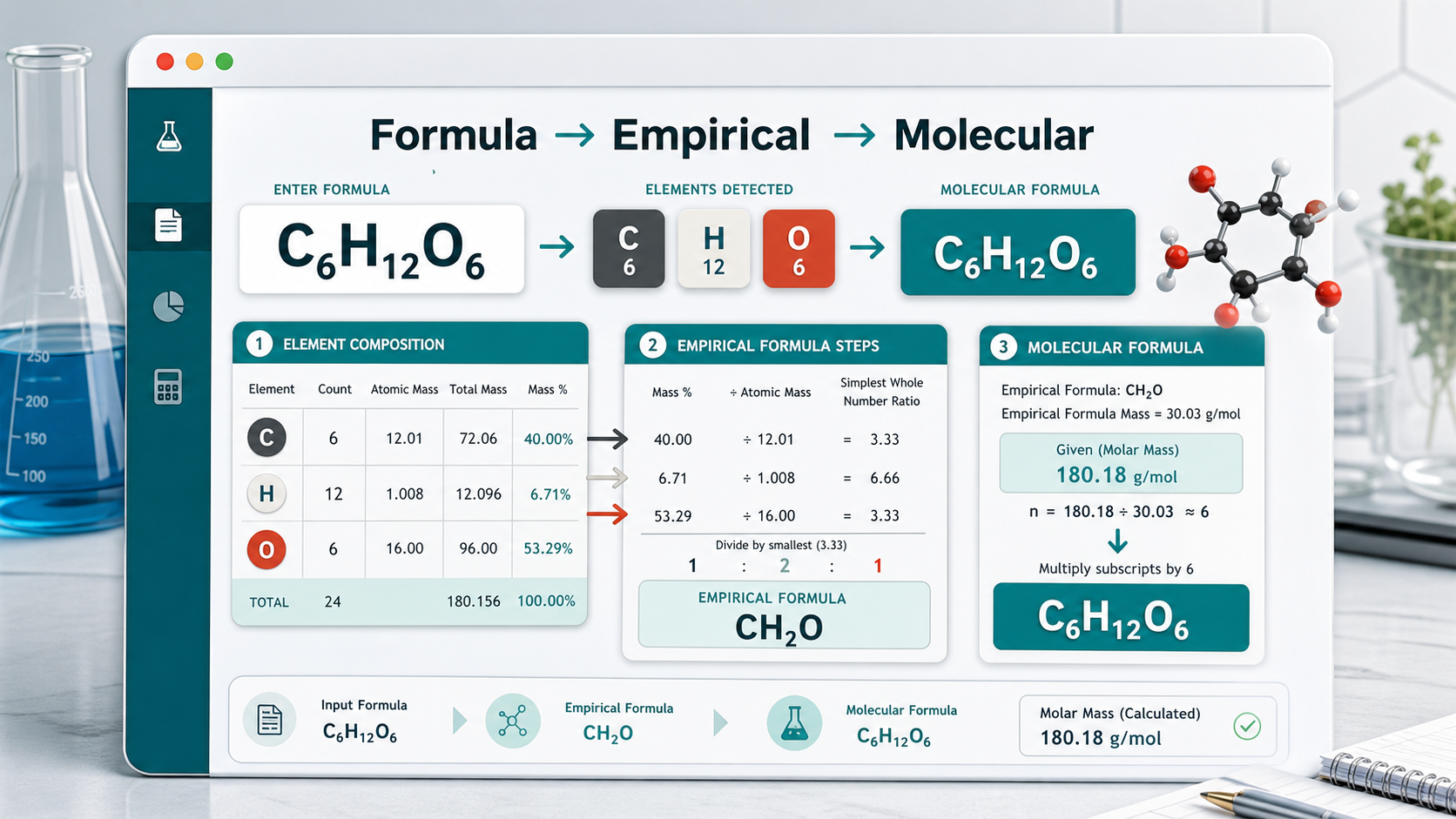
Start from a formula, element masses, or mass percentages. The Chemical Formula and Molecular Structure Solver converts composition into mole ratios, empirical formulas, molecular formulas, and formula mass.
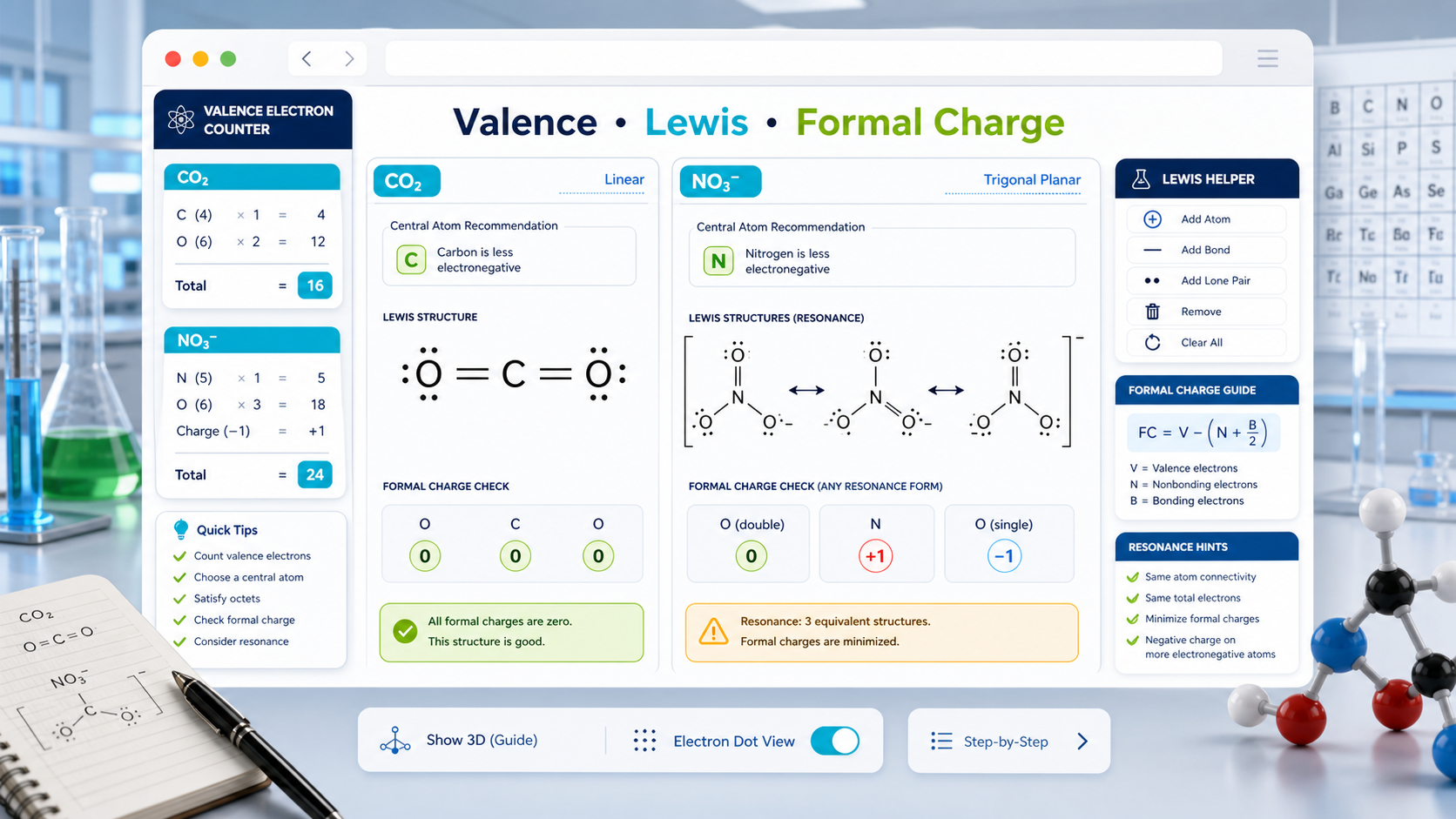
The Chemical Formula and Molecular Structure Solver estimates valence electrons, a likely central atom, AXE domains, formal charge patterns, and resonance warnings for common main-group molecules.
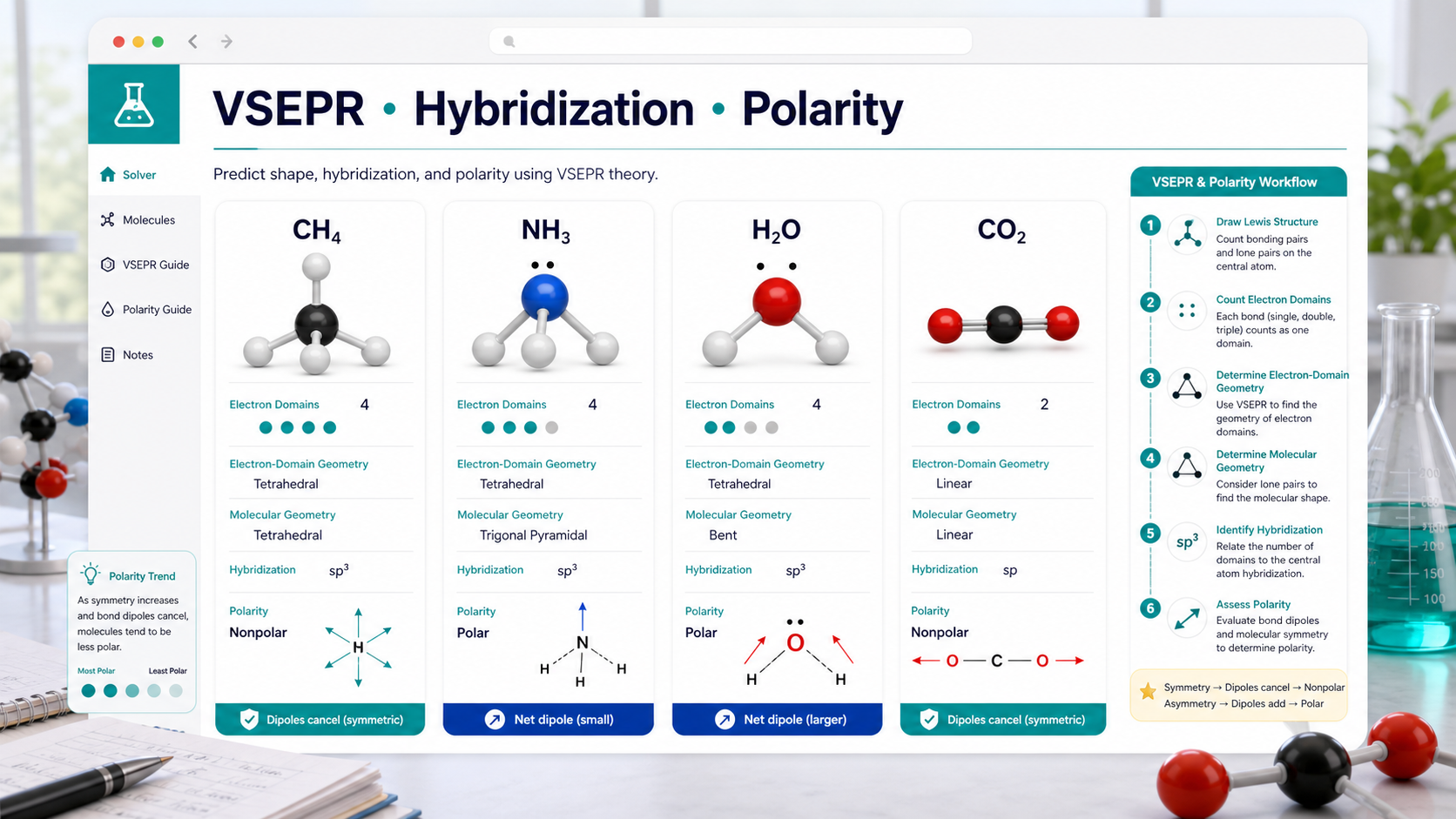
After the Lewis-style estimate, the Chemical Formula and Molecular Structure Solver maps electron domains to VSEPR geometry, basic hybridization, and a qualitative polarity trend.
The Chemical Formula and Molecular Structure Solver uses static element masses, main-group valence counts, and transparent textbook-style rules rather than hidden database lookups.
Formula symbols, parentheses, simple ion charges, and composition lines are parsed locally to build an element count table and mass contribution summary.
Mass or percentage data is converted to moles, normalized to the smallest amount, and scaled into small whole-number empirical and molecular formulas.
For common main-group formulas, the solver estimates central atom, electron domains, formal charges, VSEPR shape, hybridization, resonance hints, and polarity trend.
Use the Chemical Formula and Molecular Structure Solver when you need one place for formula mass, empirical formula, molecular formula, and first-pass structure reasoning.
Type a formula such as H2O, CO2, NH3, CH4, NH4+, SO4^2-, or Ca(OH)2. Add charge separately only when you want to override the formula charge.
Paste element masses or mass percentages when you want empirical formula and molecular formula derivation from lab-style composition data.
Use the VSEPR and Lewis output as a teaching-model check, not as an experimental structure database, exact 3D model, or quantum chemistry calculation.
If the formula has transition metals, coordination chemistry, crystal lattices, radicals, or multiple possible isomers, treat the result as a boundary warning rather than a final structure.
Common questions about Chemical Formula and Molecular Structure Solver inputs, empirical formulas, molecular formulas, Lewis structure hints, VSEPR, hybridization, polarity, privacy, and limits.
This Chemical Formula and Molecular Structure Solver combines Empirical Formula Solver, Molecular Formula Solver, Formula Mass Calculator, Molar Mass Calculator, Lewis Structure Helper, Formal Charge Checker, VSEPR Geometry Solver, Hybridization Helper, and Molecular Polarity Helper workflows on one page.
Yes. Enter one element per line, such as C: 40.00%, H: 6.71%, and O: 53.29%. The Chemical Formula and Molecular Structure Solver treats percentages as a 100 g sample, converts to moles, normalizes ratios, and reports the empirical formula process.
It first finds or parses an empirical formula, calculates its mass, then compares that mass with the target relative molecular mass or molar mass. If the ratio is close to a whole number, every empirical subscript is multiplied by that factor.
No. The Chemical Formula and Molecular Structure Solver gives first-pass teaching-model hints for common main-group formulas. It does not replace a full chemical database, spectroscopy, crystallography, quantum chemistry, or professional molecular modeling software.
No. Chemical formula parsing and structure checks run locally in your browser. No formulas or composition data are uploaded.
Transition-metal coordination compounds, organometallics, complex organic naming, crystal structures, radicals, exact conformations, and experimental structure decisions are outside scope because they need richer rules, specialized databases, professional software, or laboratory evidence.
Use SolverBox for browser-based chemistry, algebra, geometry, sequence, and puzzle-solving helpers.
Each tool keeps the working steps visible so you can check the reasoning instead of only copying a final answer.
No account required. Keep inputs local whenever a tool can run fully in the browser.