Sliding Puzzle Solver parity check
The solver counts inversions and combines them with the blank row rule for even-width boards. If parity fails, the puzzle cannot be solved by legal sliding moves.
Free Online Sliding Puzzle Solver
This Sliding Puzzle Solver combines 8 Puzzle Solver, 15 Puzzle Solver, and Number Sliding Puzzle Solver workflows in one page. Enter the current numbered tile arrangement, check whether it is solvable, then inspect move directions, each board state, total moves, and the current blank position.
Choose the board size, enter the current tile order with 0 or _ for the blank space, and the Sliding Puzzle Solver will validate parity, report solvability, and search for a shortest or heuristic path in your browser.
Higher values can find harder 15-puzzle paths, but the browser may stop early at the node limit.
Use spaces, commas, or line breaks. Enter every number from 0 to N²-1 once; 0, blank, or _ means the empty space.
Scope boundary: this Sliding Puzzle Solver does not recognize image puzzles, upload photos, read camera input, or identify real physical puzzle pictures. Enter the numbered tile arrangement manually.
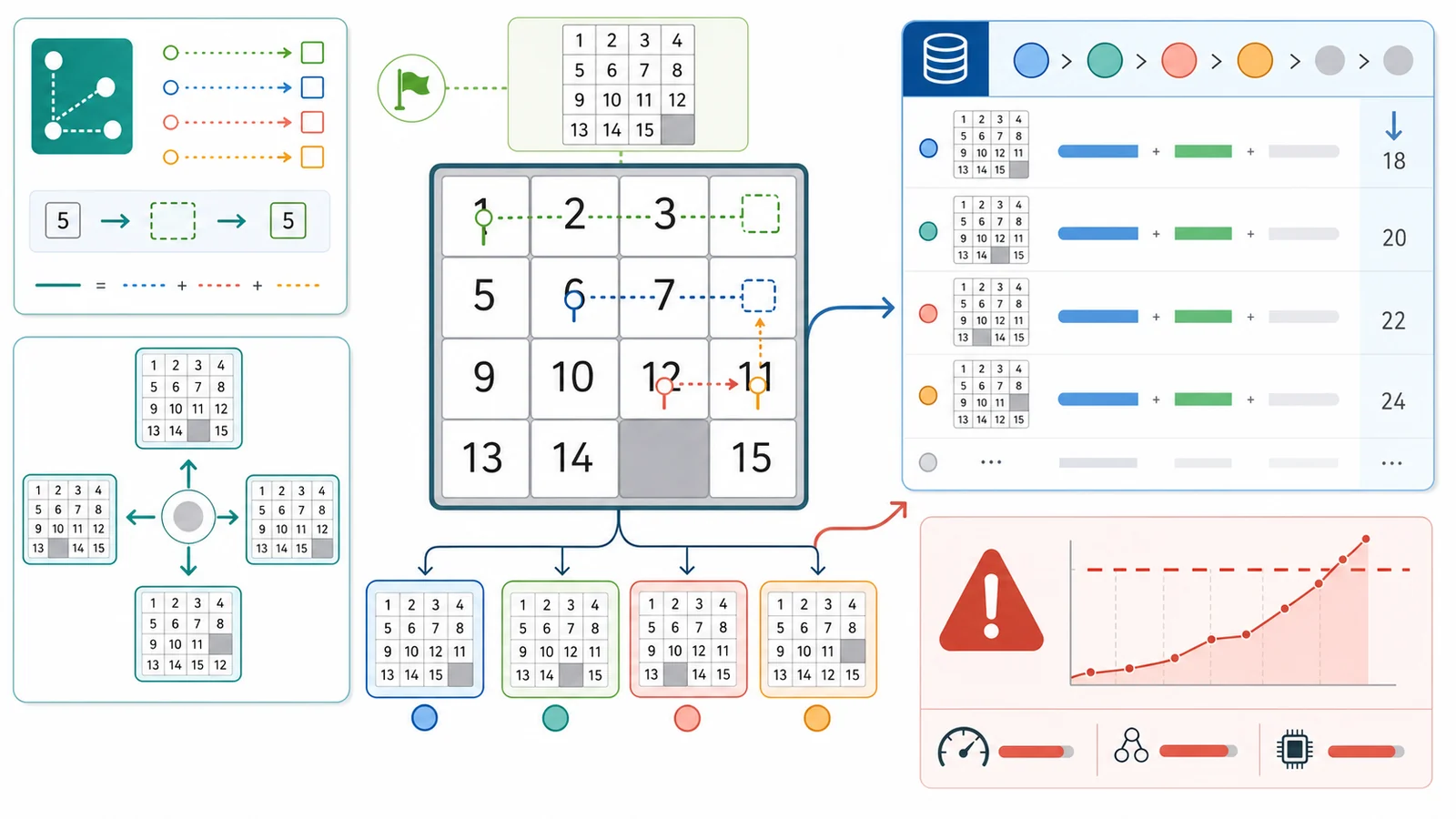
Performance boundary: complex 15-puzzle and 5×5 states can be expensive. The Sliding Puzzle Solver uses Manhattan-distance heuristic search, maximum moves, and a node cap so the browser does not lock up.
Not checked
Not checked
One Sliding Puzzle Solver page covers 8 Puzzle Solver, 15 Puzzle Solver, and Number Sliding Puzzle Solver searches without splitting them into separate tools.
Select 3×3, 4×4, or another supported square size, then type the current numbered arrangement with 0 or _ for the empty space.
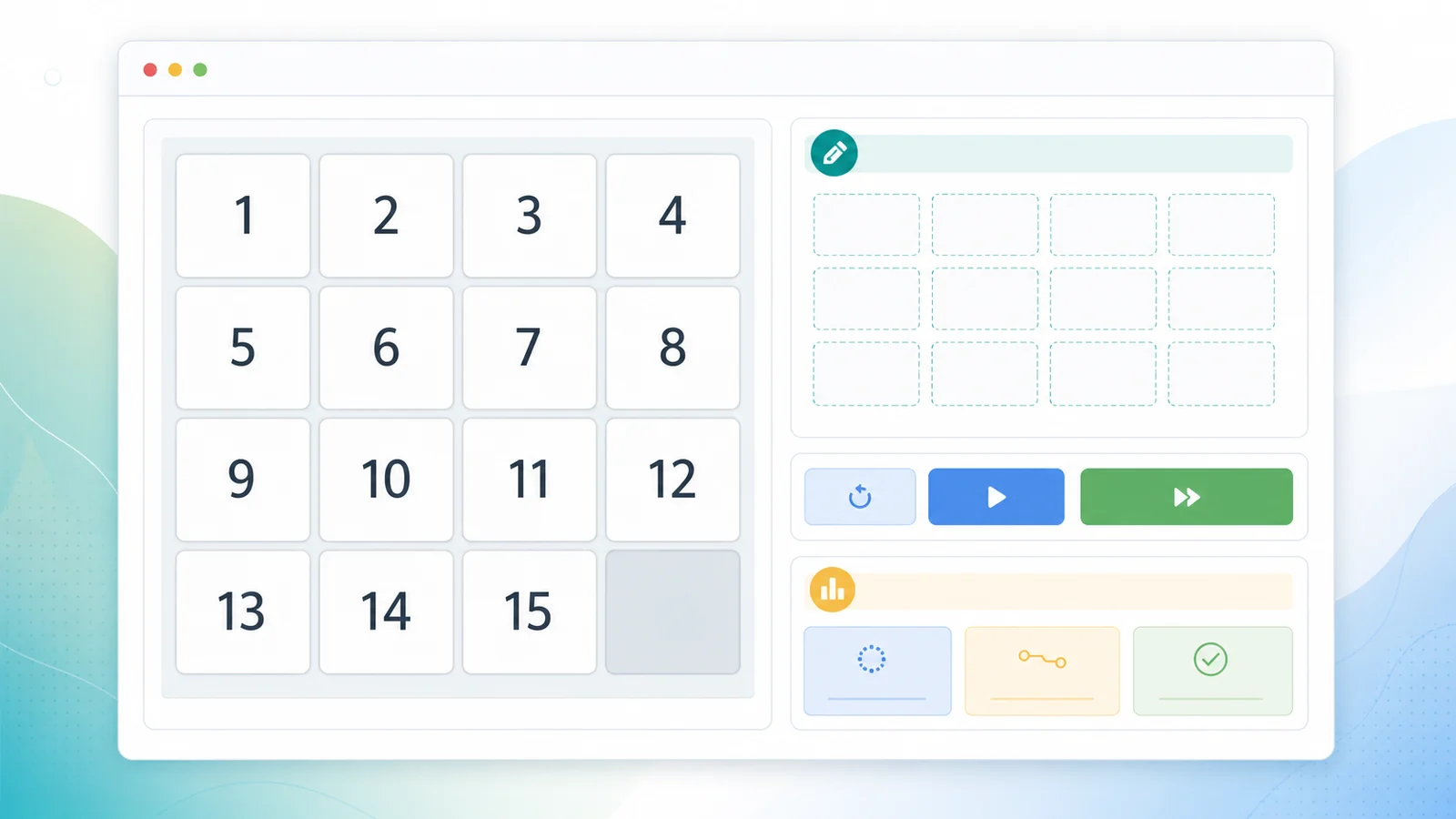
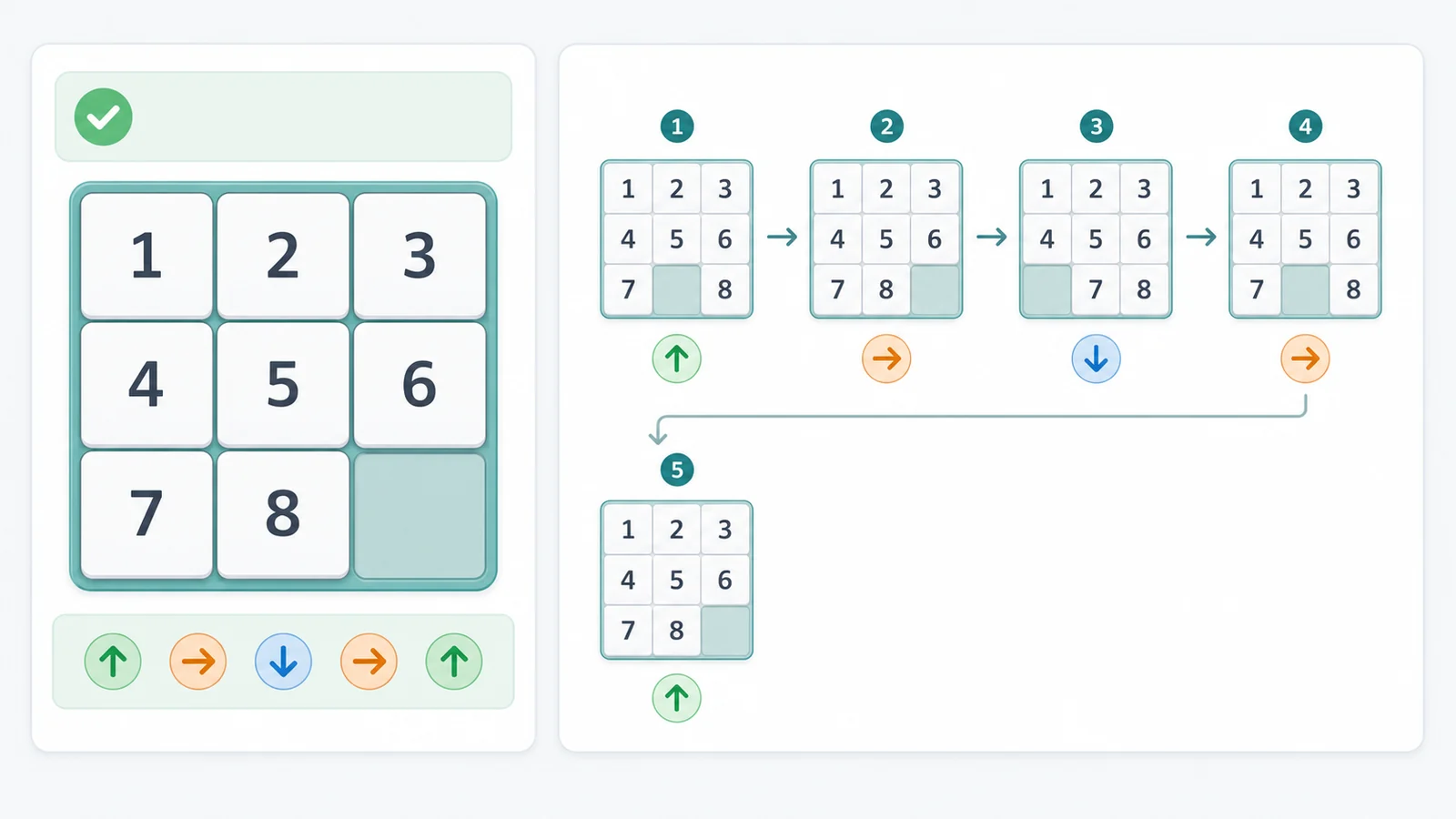
The result shows whether the puzzle is solvable, the total move count, blank-space directions, and every board state from start to goal.
Hard 15-puzzle states can be slow, so the solver uses Manhattan-distance heuristic search plus depth and node limits to keep the browser responsive.
The Sliding Puzzle Solver checks math first, then searches moves only when the entered number sliding puzzle can reach the standard goal state.
The solver counts inversions and combines them with the blank row rule for even-width boards. If parity fails, the puzzle cannot be solved by legal sliding moves.
For 3×3 puzzles the tool uses A* with Manhattan distance to return a shortest path. Larger boards use a weighted heuristic mode with caps for responsiveness.
The page solves numeric tile orders only. It does not upload pictures, identify photos, segment jigsaw images, or read a real puzzle from a camera.
Use these tips to format an 8-puzzle, 15-puzzle, or Number Sliding Puzzle Solver board correctly before searching.
Pick the square size that matches the puzzle: 3×3 for an 8-puzzle, 4×4 for a 15-puzzle, or another supported number sliding puzzle size.
Type the board exactly as it appears now, row by row. Spaces, commas, and line breaks are accepted, so both compact and grid-style input work.
If the puzzle is solvable, read the blank-space move directions and inspect every board state. If search hits a limit, try a closer state or raise the maximum moves carefully.
For 15-puzzle positions that are far from solved, solvability can be proven quickly even when finding a complete path would be too expensive for the browser.
Common questions about Sliding Puzzle Solver input, 8 Puzzle Solver and 15 Puzzle Solver support, solvability, limits, and image-recognition boundaries.
Yes. This single Sliding Puzzle Solver page handles 3×3 8-puzzle boards, 4×4 15-puzzle boards, and other supported square number sliding puzzles. They are intentionally combined instead of split into separate pages.
The Sliding Puzzle Solver checks inversion parity. Odd-width boards are solvable when the inversion count is even. Even-width boards also use the blank row counted from the bottom.
For 3×3 boards, the Sliding Puzzle Solver uses A* with Manhattan distance and reports a shortest path when found. For larger boards, the page may use weighted heuristic search, so the path can be near-shortest rather than mathematically optimal.
Some 15-puzzle positions need deep searches and large state spaces. The Sliding Puzzle Solver sets maximum move and node limits so the browser remains responsive instead of freezing.
No. This Sliding Puzzle Solver does not upload images, identify tiles in photos, read camera input, or solve picture jigsaws. Enter the tile numbers manually.
Move directions describe the blank space: Up means the empty square moves one row up, Down means it moves one row down, and so on. The board-state timeline shows the result after each move.
No. Parsing, solvability checks, heuristic search, move directions, and board-state rendering run in front-end browser JavaScript after the page loads.
SolverBox keeps Sliding Puzzle Solver focused on numbered sliding tiles, while Sudoku, Kakuro, KenKen, and other tools handle different puzzle rules.
After using this Sliding Puzzle Solver, browse all free puzzle solvers for more number, logic, word, and game helpers.
No account required — enter a number sliding puzzle and solve it in your browser.