Sequence Solver arithmetic and geometric checks
The tool compares first differences for arithmetic sequences and ratios for geometric sequences, including the next value and a compact nth-term formula when the pattern fits.
Free Online Sequence Solver
This Sequence Solver combines Number Sequence Solver, Find the Next Number Solver, Arithmetic Sequence Solver, Geometric Sequence Solver, and Pattern Solver use cases on one page. Sequence patterns are checked locally in your browser. The result may have multiple valid interpretations.
Type known terms such as 2, 4, 6, 8, ? or 1, 1, 2, 3, 5, 8, ?. The Sequence Solver checks common mathematical patterns in your browser and shows candidate next terms, formulas, and cautions.
Sequence patterns are checked locally in your browser. No sequence data is uploaded, and the tool does not call an AI service or answer database.
The Sequence Solver keeps next-number, arithmetic, geometric, square, cube, Fibonacci, and Pattern Solver workflows together because users need to compare several reasonable explanations in one place.
Paste a list like 2, 4, 6, 8, ? or 1, 1, 2, 3, 5, 8, ?. The trailing question mark is optional, and the known values stay in your browser.

Review arithmetic, geometric, square, cube, Fibonacci, and finite-difference checks side by side instead of splitting the same problem across separate mini tools.
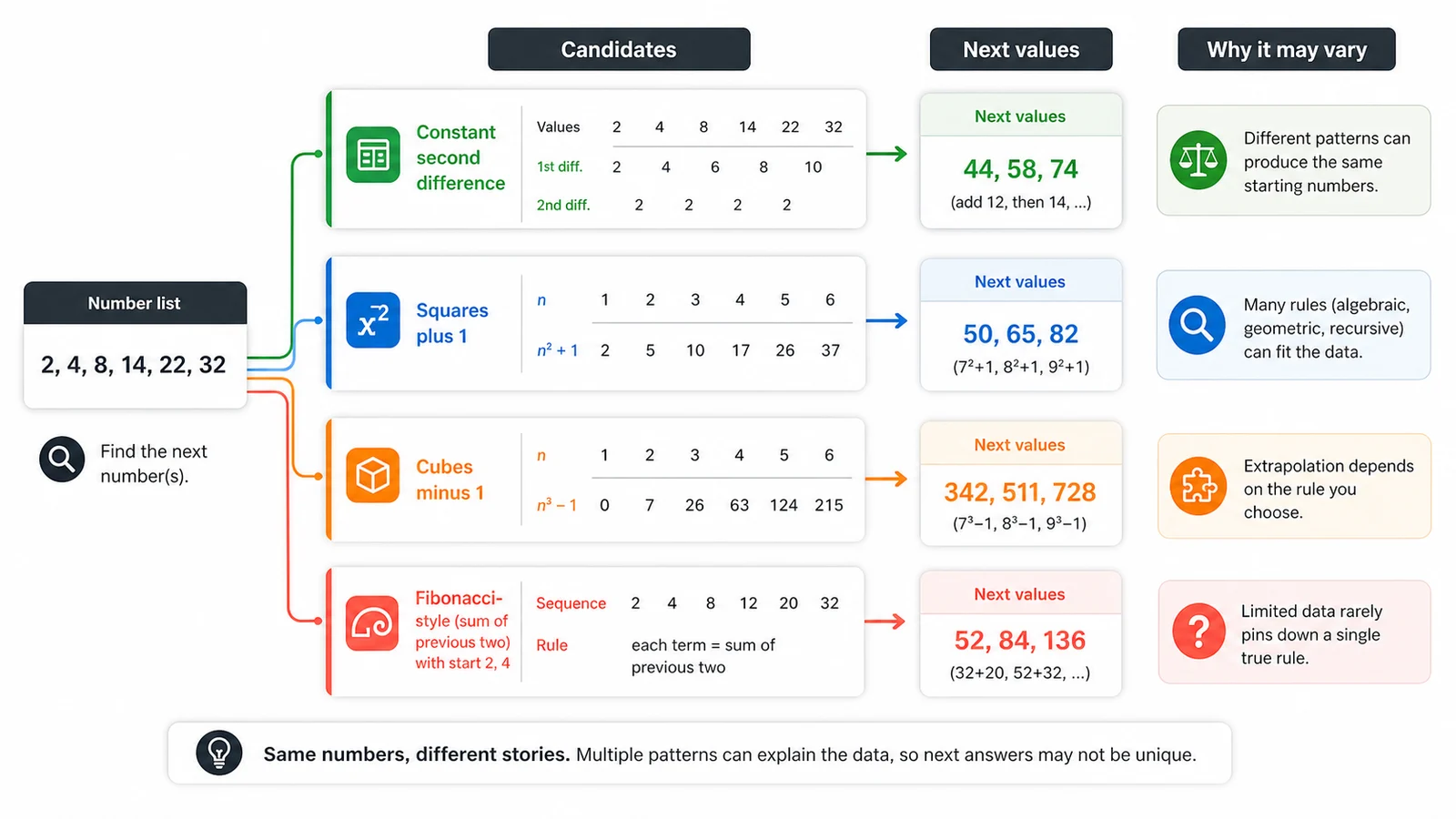
Inspect a next term, a possible nth-term formula, difference rows, and a clear note about why finite sequences may have more than one valid continuation.
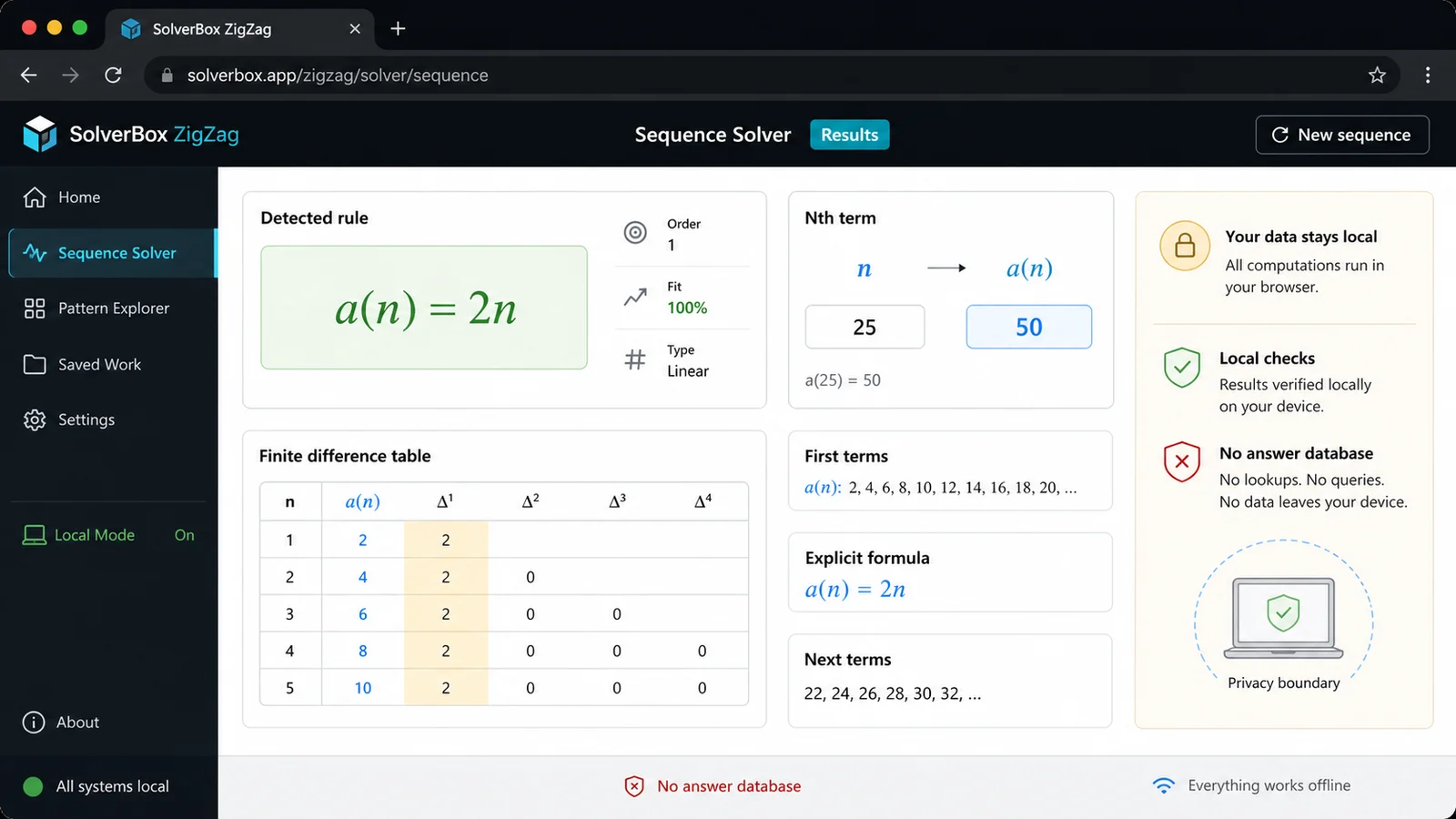
The Sequence Solver runs deterministic browser-side checks for common number sequence families, then ranks matching explanations without claiming that the finite list has one guaranteed answer.
The tool compares first differences for arithmetic sequences and ratios for geometric sequences, including the next value and a compact nth-term formula when the pattern fits.
Perfect-square roots, perfect-cube roots, and Fibonacci-style sums are checked as separate candidates, so examples like 1, 4, 9, 16 and 1, 1, 2, 3, 5, 8 are easy to audit.
When repeated differences become constant, the Sequence Solver can extend the difference table and show a Newton-style nth-term expression, while warning that interpolation is not uniqueness.
Use the Sequence Solver when you have known numeric terms and want to compare common next-number explanations without uploading the puzzle.
Type only the known numbers in order. Commas, spaces, semicolons, and line breaks are accepted, and a final ? can be included if the original puzzle shows one.
A simple sequence can satisfy more than one rule. Check the candidate reason, next term, formula, and pattern family before deciding which explanation matches your puzzle context.
The page is a common-pattern helper, not an AI guesser or answer bank. If a worksheet, contest, or puzzle gives extra context, use that context to choose among valid candidate rules.
For a finite sequence, infinitely many formulas can pass through the same known terms. The Sequence Solver surfaces practical candidates instead of pretending uniqueness.
Common questions about Sequence Solver inputs, next-number answers, formulas, arithmetic and geometric sequences, finite differences, privacy, and non-unique patterns.
This Sequence Solver combines the shared workflow behind Number Sequence Solver, Find the Next Number Solver, Arithmetic Sequence Solver, Geometric Sequence Solver, and Pattern Solver searches. You enter one sequence and compare several common mathematical interpretations together.
Yes. The Sequence Solver recognizes a constant difference of 2, reports an arithmetic sequence, gives 10 as the next term, and shows a formula such as a(n) = 2 + (n − 1) × 2.
Yes. When each nonzero term has the same ratio to the previous term, the Sequence Solver marks the geometric check as matching and reports the next term and formula.
A finite list of numbers can be extended by many valid rules. The Sequence Solver checks common patterns and ranks candidates, but it does not claim the sequence has a unique mathematical answer unless the puzzle context supplies that rule.
No. The Sequence Solver runs deterministic JavaScript checks in your browser. It does not do AI guessing, connect to a question bank, or search an exam answer database.
It means the Sequence Solver did not recognize arithmetic, geometric, square, cube, Fibonacci, or supported finite-difference patterns for the entered terms. A different or context-specific rule may still exist.
No. The Sequence Solver parses the numbers, checks patterns, creates candidate explanations, and formats copyable results locally after the page loads.
SolverBox keeps this Sequence Solver focused on common number patterns, next terms, formulas, and ambiguity notes.
After checking a sequence, browse more free solvers for Sudoku, Kakuro, KenKen, word puzzles, logic grids, and game helpers.
No account required — enter a sequence and check patterns locally in your browser.