Puzzle Solver Guide
How Our Free Online Sudoku Solver Works
A plain-English explanation of the backtracking algorithm that powers the SolverBox free Sudoku solver, and why it solves any valid 9x9 puzzle in milliseconds.
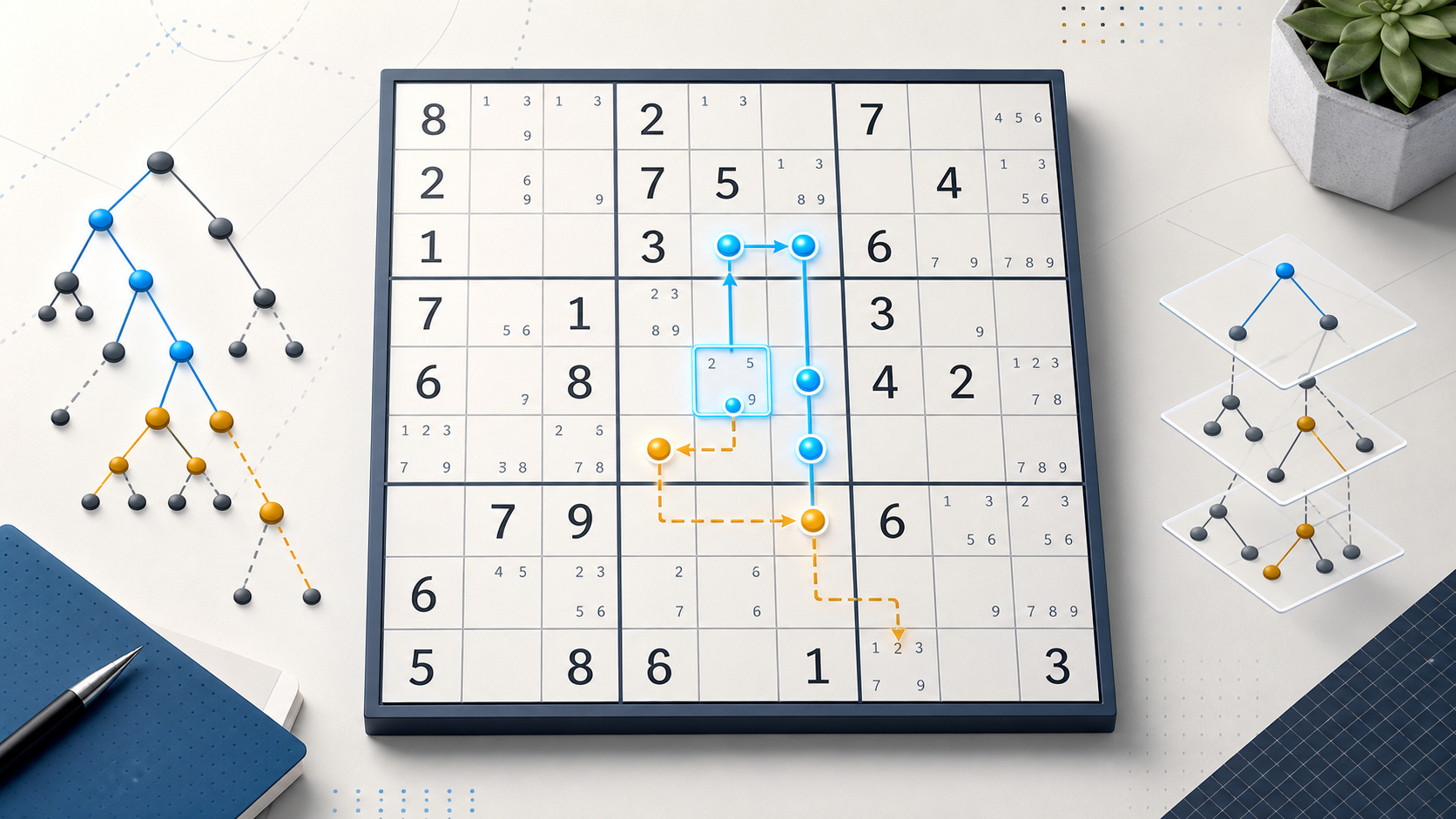
If you’ve ever used a free online Sudoku solver and wondered how it actually finds the answer, this post is for you. We’ll walk through the algorithm that powers SolverBox’s Sudoku solver step by step — in plain English, no math degree required.
What makes Sudoku hard to solve by computer?
A 9x9 Sudoku grid has 81 cells. If the puzzle gives you 25 clues, that leaves 56 empty cells to fill. Even knowing that each digit must appear exactly once per row, column, and 3x3 box, a pure brute-force search would need to try billions of combinations. That’s too slow.
The smarter approach is backtracking — and it’s what our free Sudoku solver uses.
How the backtracking algorithm works in the Sudoku solver
The backtracking algorithm treats Sudoku as a constraint satisfaction problem. Here’s what happens each time you hit Solve:
Step 1 — Find the first empty cell
The Sudoku solver scans the grid from left to right, top to bottom, until it finds a cell that contains 0 (empty).
Step 2 — Try digits 1 through 9
For each empty cell, the solver tries placing the digit 1. Then it checks three constraints:
- Row constraint: Is this digit already in the same row?
- Column constraint: Is this digit already in the same column?
- Box constraint: Is this digit already in the same 3x3 box?
If all three checks pass, the solver tentatively places the digit and moves to the next empty cell.
Step 3 — Recurse and backtrack
The solver continues filling cells recursively. If it reaches a cell where no digit from 1-9 is valid, it backtracks: it erases the last placed digit and tries the next one.
This process continues — placing digits, checking constraints, backtracking when stuck — until either the puzzle is solved, or no solution exists.
Why is it so fast?
On most practical Sudoku puzzles, the backtracking algorithm runs in under 50 milliseconds in your browser. Constraints prune the search space dramatically. Most cells have only 1-3 valid candidates, not all 9 digits. And when the solver places a wrong digit early, it catches the conflict quickly and backtracks without exploring the millions of paths that digit would have led to.
Try the free Sudoku solver yourself
Now that you know how it works, see it in action. Head to our free Sudoku solver and click “Load a sample puzzle” to watch the backtracking algorithm solve a real puzzle in milliseconds.
Have a puzzle to solve? Paste your grid and hit Solve — no account, no install, completely free.